
Democratic Republic of Congo - Ebola response: Strengthening treatment and preserving essential care
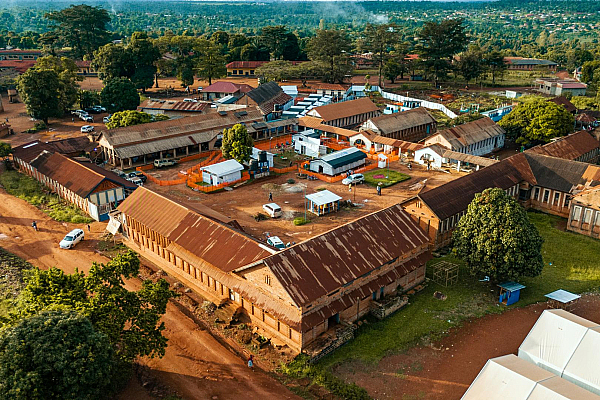
“We were separated only by ropes.” When Dr Prince Afandia Alafu, 33, returns to the place where he was treated for Ebola, memories of his hospitalization resurface. In Isiro, in Haut Uélé province in northeastern of the Democratic Republic of the Congo, this general practitioner discovers, just weeks after his recovery, an expanded and better equipped treatment centre. Progress has been made to improve care for Ebola patients while allowing the hospital to gradually resume its usual activities.
A few days before his admission, Dr Prince experienced persistent fever and headaches, which he initially attributed to malaria or typhoid. A test confirmed his infection with the Bundibugyo virus, responsible for the current Ebola outbreak. Accustomed to treating others, he suddenly became a patient himself. After several days of care, he managed to overcome the disease.
On August 24, when he was admitted to the Isiro Ebola Treatment Centre (ETC), the facilities were still rudimentary. Spaces were cramped and care conditions difficult. Today, the centre has 50 beds and appropriate equipment. “There has really been a big improvement. Now there is electricity and water. The rooms are maintained regularly, and the conditions of care have changed,” he notes.
Behind these changes lie the story of a hospital deeply shaken by the epidemic. Before Ebola arrived, the Isiro General Reference Hospital (GRH) had 130 beds and provided internal medicine, surgery, pediatrics, and obstetrics gynecology care, with an occupancy rate above 90%. When the first cases appeared in July 2026, the facility had to reorganize its services.
“We had to move the pediatric ward. The pediatric pavilion became the first nucleus of the ETC within the hospital. With the increase in cases, we had to mobilize a second pavilion,” explains Dr David Kamalu, director of the GRH. The presence of Ebola patients in hospital buildings and fear of contamination gradually drove other patients away. According to Dr Kamalu, bed occupancy dropped to 30% in August.
For medical teams, the challenge was immense: treating Ebola patients without interrupting care for pregnant women, children, and patients with other illnesses.
As of 19 October 2026, 7 of the 13 health zones in Haut Uélé were affected by the Ebola outbreak. The province had recorded 421 confirmed cases, including 180 deaths. Isiro health zone was among the hardest hit.
Under the leadership of the Ministry of Health, with support from WHO and partners, the ETC — initially with 40 beds — was expanded to 50 beds in collaboration with Médecins Sans Frontières (MSF). “This extension allows us to strengthen reception capacity and improve care for Ebola patients. It helps secure care circuits and reduce transmission risks,” emphasizes Dr Catherine Smallwood, WHO incident manager. “By having an adapted treatment centre, we also help the hospital gradually resume its usual activities.”
The effects are already visible. Patients who had deserted the hospital out of fear are gradually returning. Today, we have about 55 patients hospitalized. Now that the centre is secure and circuits are better organized, patients are starting to come back for their usual care,” notes Dr Kamalu.
Improved treatment capacity is accompanied by other interventions to preserve health services. WHO has delivered more than a ton of medicines, supplies, and medical equipment to the GRH, including oxygen therapy materials, personal protective equipment, beds, and mattresses, to support continuity of essential care.
In Haut Uélé, health authorities also launched vaccination of frontline personnel for research purposes with the ERVEBO vaccine. Nationally, more than 9,000 agents have been vaccinated as part of this study. The effectiveness of this vaccine against the Bundibugyo Ebola virus, responsible for the current outbreak, is still under investigation.
For Dr Steve Ahuka, incident manager of the Presidential Task Force dedicated to the Ebola response, complementarity of interventions is essential. “When we prevent through vaccination, when we treat the disease, when we raise awareness through survivors — these packages of activities are what make the disease recede,” he explains.
For Dr Prince, the improvements are deeply meaningful. Having faced the challenges of the epidemic’s early weeks, he now sees how better care and stronger prevention are giving patients hope and helping rebuild community trust. His experience shows that Ebola does not have to be fatal: timely, appropriate care can save lives.
“With the progress made in the response and the improvement of care conditions, I have hope that more patients will overcome Ebola, reunite with their families, and resume their normal lives.”
Distributed by APO Group on behalf of WHO Regional Office for Africa.Distributed via APO Group / Africa Newsroom
View original ↗