
Democratic Republic of Congo – Taking care of others despite fear: a doctor facing Ebola
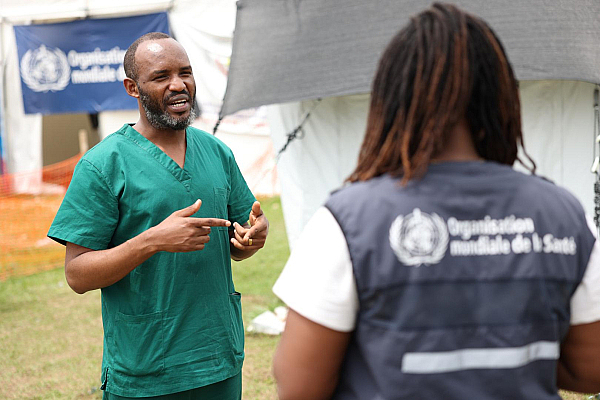
During an outbreak, health professionals accompany patients and their families at every stage of their care journey. Behind this daily commitment lie fears, stress and personal trials. For Dr Elvis Mani Rodrigo, a doctor engaged in the Ebola response in Bunia, this reality took on a deeply personal dimension when a member of his family contracted the disease.
At the Ebola treatment centre of Bunia General Hospital, Dr Rodrigo meets patients every day who are often worried about their health and that of their loved ones, many of whom fear they will not survive the disease.
Assigned to the centre for several months, he works with suspected and confirmed cases. Alongside other members of the team, he provides medical care and psychological support.
“Ebola is very traumatic. Many patients arrive with fear of dying. We are here to treat them, but also to accompany them through this difficult ordeal,” he explains.
For Dr Rodrigo, caring for patients is not only about prescribing treatment. It also means listening, reassuring and restoring hope. “We try to be present, attentive and close to the patients. When they feel they are not alone, they regain confidence and hope,” he says.
This conviction was strengthened through a personal experience that profoundly marked his life.
At the height of the outbreak, his wife, a laboratory technician at Bunia General Hospital, was involved in surveillance and sample collection. A few weeks later, she began to feel extreme fatigue, then developed fever and cough. Tests eventually confirmed that she had contracted Ebola.
For the doctor, this period was among the most difficult of his life. For nearly three weeks, his wife fought a severe form of the disease. Although he was considered a high risk contact, he chose to remain by her side throughout her treatment. “After living with my wife, I was already considered a high risk contact. I could not move away from her. I stayed by her side,” he recalls.
While trying to reassure her and restore her confidence, he lived with the constant worry of developing the disease himself. His wife eventually recovered, but the ordeal gave him a deeper understanding of what patients and their families endure.
At the Ebola treatment centre, this experience continues to shape the way he supports patients. He knows how much fear, uncertainty and isolation weigh on them and their families.
Beyond medical care, he stresses the importance of supporting families and relatives during and after the illness. “Psychological support for the family and loved ones is very important to properly welcome a person who has recovered,” he emphasises.
What he experienced alongside his wife reinforced his conviction that listening, support and human presence are as important as medical care in the management of people affected by Ebola.
Today, he better understands the fears of those facing the disease and the importance of human support in difficult times.
His story highlights a reality often overlooked: those who care for others also need support. Preserving their mental health is essential not only for their well being, but also to enable them to continue accompanying patients, families and communities affected by Ebola.
As the Ebola response continues, Dr Elvis continues to share the same message with those he receives at the treatment centre: “I would like to tell people going through difficult times not to give up and to come quickly to the hospital as soon as symptoms appear. The earlier you come, the greater the chances of receiving the care needed to recover,” he affirms.
His story is a reminder that mental health must be considered throughout an epidemic, not only for patients and their families, but also for the health professionals who accompany them every day.
Distributed by APO Group on behalf of WHO Regional Office for Africa.
Distributed via APO Group / Africa Newsroom
View original ↗