
Free Surgery with Mercy Ships Helps Sierra Leonean Girl Reclaim Her Childhood
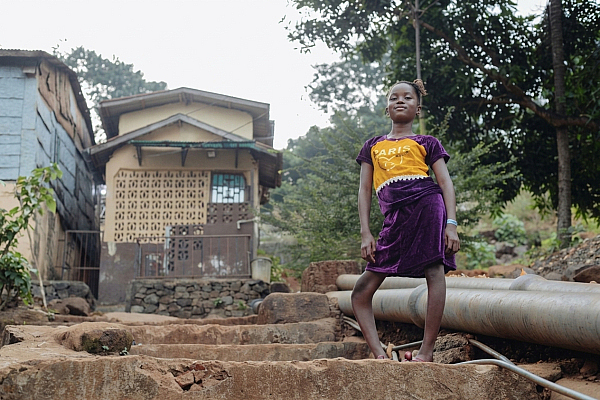
For nine-year-old Baindu, playing outside with other children often ended in isolation. Her bowed legs were so painful and difficult to manage that she spent most of her childhood indoors, watching them do things she longed to do.
In Kamasu, a village in Sierra Leone’s Kenema District, children often help their families with everyday tasks such as working in the fields, fetching water, and preparing food. Baindu’s condition made each of these activities challenging.
“Baindu was really limited by her legs. She couldn’t fetch water, pound rice or climb the bed. She needed help,” said her grandmother, Mamie.
Walking long distances was also extremely painful for Baindu. Attending school, however, meant making that journey. Even after making the long, difficult trek every day, what should have been a place of learning and friendship became one more source of distress.
“Whenever I went to school, people ridiculed me and said, ‘she is walking and her legs are upside down.’ That’s why I decided to stop going to school,” Baindu explained.
Mamie remembers first noticing Baindu’s bowed legs when she was still just a baby. As Baindu grew, the condition worsened, limiting her mobility and negatively affecting her confidence. Efforts to find solutions through traditional medicinal approaches brought no improvement.
“Seeing Baindu in that condition, not able to walk properly…it made me heartbroken,” she said.
The family’s circumstances finally began to shift when Baindu’s uncle heard about Mercy Ships and the safe, free surgeries they were bringing to Sierra Leone through a field service. He helped her register for surgery, and Mamie insisted that she would accompany her to the floating hospital.
“I said if there is no other person to take her there, I will. Just to see her standing,” she said, determined to help her take hold of this opportunity for a better future.
Once on board the Global Mercy™, Baindu was diagnosed with Blount’s disease. Blount’s disease, also known as tibia vara, is a growth disorder that affects the upper part of the shinbone and causes the lower leg to bow outward. Unlike the bowing that commonly occurs during normal childhood development and may correct itself as a child grows, Blount’s disease can progressively worsen and cause lasting disability without appropriate treatment.
“She came to us with bowed legs. Her right leg was the more bowed leg with about 60 degrees of malalignment,” explained Dr. Johannes Kolbe, a volunteer pediatric orthopedic surgeon from Germany.
Referring to Baindu’s condition, Dr. Kolbe explained, “You cannot stop this without surgical procedure.”
Baindu underwent a three-and-a-half-hour surgery to correct the alignment of her legs.
Surgery was only the beginning of Baindu’s journey. Recovery required a sustained period of rehabilitation, with exercises designed to strengthen her muscles, improve balance, and help her adjust to her newfound mobility.
“First, we worked on bed exercises like lifting the leg up into the air, reaching her toes, and laying on her belly,” said Jaclyn Beaumont, a volunteer physical therapy assistant from the USA.
As Baindu progressed, she moved from tentative steps and practicing her balance to climbing stairs. For Mamie, watching her granddaughter’s straightened legs take more confident strides brought immense delight.
After spending five months, Baindu and Mamie returned to their village. Their family and community welcomed them with singing and celebration.
Reflecting on how far she has come, Baindu said, “I didn’t think my legs would be straight. I thought I would stay like this [with bowed legs] until I am grown up.”
Her dreams stretch beyond what once felt possible. “The thing I hope for in the future is to become a doctor, because doctors heal people,” she said.
Distributed by APO Group on behalf of Mercy Ships.
For more information about Mercy Ships, contact:
international.media@mercyships.org
ABOUT MERCY SHIPS:
Mercy Ships is a global Christian NGO that partners with African nations to expand access to safe surgical care through direct surgical services, training and mentoring, and health systems strengthening. Founded in 1978, Mercy Ships has focused its work in Africa for more than 35 years. Each year, more than 2,500 volunteer professionals from over 70 countries serve on board the world’s two largest non-governmental hospital ships, the Africa Mercy® and the Global Mercy™, as well as on the ground, partnering locally with in-country programs. For more information, visit www.MercyShips.org and follow @MercyShips on social media.
Distributed via APO Group / Africa Newsroom
View original ↗