Uganda: Musasizi defends additional State House funding
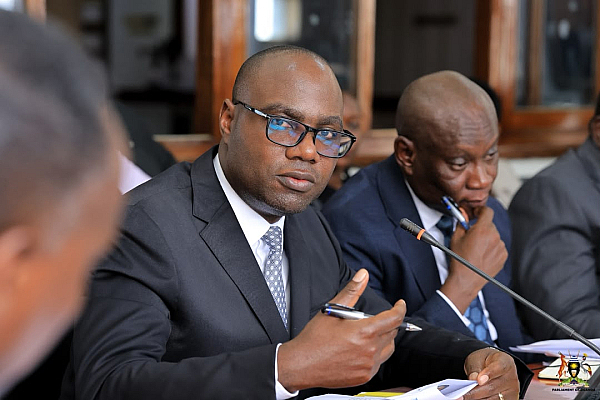
The Minister of Finance, Planning and Economic Development, Hon. Henry Musasizi has defended additional funding to State House, saying government must ensure the President has sufficient resources to perform his duties.
State House spent Shs982 billion against an original allocation of Shs119 billion in the budget of the financial year 2025/2026, prompting questions from the Budget Committee about the additional Shs862 billion.
The committee, chaired by Hon. Amos Kankunda, was examining the Annual Budget Performance Report and the Macroeconomic and Fiscal Performance Report for the financial year 2025/2026.
Appearing before the committee on Wednesday, 11 November 2026, Musasizi said that the State House Accounting Officer had requested supplementary funding to cover shortfalls in classified expenditure that was provided through an approved supplementary budget.
He argued that his ministry cannot predict the adequate amount of money required for State House during the budgeting season.
“I cannot reliably estimate that State House will spend this much in a year yet we are duty bound to facilitate the President. There cannot be a time when the President is unable to carry out his duties because of lack of money,” said Musasizi.
The Shadow Minister for Presidency, Hon. Harriet Nakwede, questioned the continuous allocation of supplementary funds to State House, saying the ministry should guide State House during the budgeting process.
“My issue is not how much money is given to them, but why can’t the ministry guide them during budgeting [process] such that the supplementary [budget] is not abnormal?” asked Nakwede.
Minister Musasizi also explained that an additional Shs2.71 trillion spent under the Governance and Security Programme supported the 2026 general elections, monitoring of the Parish Development Model and classified expenditure requirements omitted from the original budget.
“The bulk of these expenditures were under Internal Security Organization, Ministry of Defence and Veteran Affairs, Electoral Commission, Uganda Police and State House,” he said.
The committee also questioned low disbursements for externally funded projects, noting that government continued servicing loans for projects that had either stalled or failed to start. They were cognisant that only 33.7 percent of project loans and 34.6 percent of project grants were disbursed.
Musasizi reiterated that “due to lengthy negotiations with probable financiers some projects did not reach financial closure in the 2025/2026 financial year.”
“Procurement bottlenecks affected projects such as the Greater Kampala Metropolitan and the Rehabilitation of Kampala-Malaba Metre Gauge Railway projects,” he added.
According to the report Shs2,096 billion allocated to the Standard Gauge Railway and Shs650 billion for the oil refinery had not been disbursed, prompting the minister to assure MPs that engagements with the World Bank and other funding agencies were helping to address implementation bottlenecks.
Rakai District Woman MP, Hon. Juliet Kyinyamatama, weighed in on the bottlenecks and urged the ministry to resolve procurement and other gaps such as feasibility studies before loans are approved.
“We would like to know some of those weaknesses on the side of the World Bank such that we determine to maneuver these loans. How does a project take long to start because of negotiations?” asked Kyinyamatama.
Busia District Woman MP, Janet Anyango also raised concerns about delays in commencement of an irrigation project intended to serve Kibuku and Busia districts.
Distributed by APO Group on behalf of Parliament of the Republic of Uganda.
Distributed via APO Group / Africa Newsroom
View original ↗