

On Missing Paintings, Market Records, and Who Really Controls African Art
A gallery in Cape Town is accused of holding artists’ work hostage. An 82-year-old Ghanaian sculptor just outsold everyone at Frieze New York. Both stories are about the same thing.
This week, the African art world has two stories running simultaneously that could not appear more different on the surface. One is a scandal unfolding on social media, with artists publicly asking a Cape Town gallery where their paintings are. The other is a triumph: an octogenarian Ghanaian sculptor making $4.1 million in a single morning at Frieze New York, outselling Baselitz, Rauschenberg, and Turrell in one of the most commercially significant moments for African art in years. Read together, they tell you everything you need to know about where African art stands in 2026: extraordinary in its creative and commercial power, and still, in too many rooms, vulnerable.
Where Is the Painting?
On July 2, South African artist Kate Gottgens posted an image of her 2011 painting Audible Doom to Instagram. The post was simple and devastating. “Has anyone seen this painting?” she wrote.
Gottgens had shown the work through SMAC Gallery, one of Cape Town’s most prominent commercial galleries with a roster that has included exhibitions at Art Basel, The Armory Show, Art Brussels, and ARTISSIMA. Audible Doom was displayed at the Miart fair in Milan in 2022. It did not sell. It was not returned. In spite of repeated requests over four years, she says, neither the work nor payment for it has materialised. She has since deleted the post, but the conversation it started has not gone away.
She is not alone. ARTnews spoke to multiple artists and former staff members, some requesting anonymity, who described similar experiences. The gallery’s roster, which listed as many as 28 artists between 2011 and 2022, has shrunk to 14. Jody Paulsen, a Cape Town-based artist, confirmed that other artists had experienced the same frustrations.
SMAC responded that “the majority of issues outstanding have been resolved” and accused departing artists of “inexplicable malice” and “dissemination of false narratives.” As of July 8, however, a logistics company in Milan confirmed to Gottgens that they were holding three of her works. Audible Doom was originally part of that group and remains unaccounted for.
This is not a story about one bad gallery. It is a story about power. The relationship between African artists and the galleries that represent them has historically been weighted heavily toward the institution: the gallery controls access to fairs, to collectors, to the international market. Artists, particularly those without legal resources or established reputations, often have little recourse when things go wrong. The fact that it took a public Instagram post to surface what four years of private requests could not resolve tells you something important about where that power still sits.
Artist Spotlight: El Anatsui at 82, Still Outselling Everyone
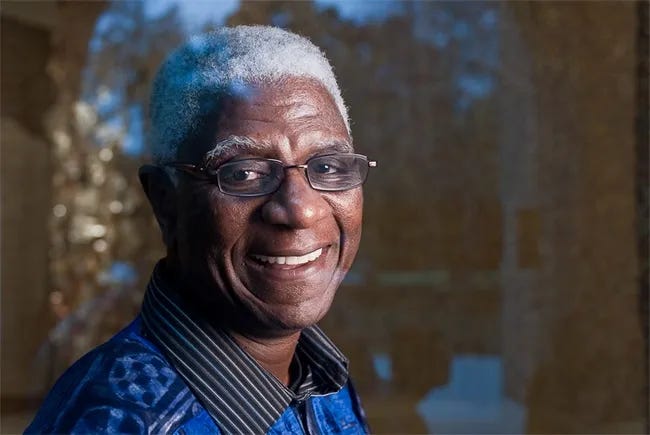
On the opening morning of Frieze New York 2026, White Cube’s booth sold two works by El Anatsui for a combined $4.1 million. LuwVor I (2025) went for $2.2 million, making it the highest publicly reported single sale of the fair. MivEvi III (2025) sold for $1.9 million. Together they made White Cube the top-selling gallery of the week, ahead of Thaddaeus Ropac with a $1.4 million Baselitz, and Almine Rech with a Turrell in the $900,000 to $1 million range.
Let that land for a moment. El Anatsui, 82 years old, working from his studio in Nsukka, Nigeria, making art from discarded bottle caps and copper wire, outsold some of the most blue-chip names in the Western canon at one of the world’s most commercially significant fairs.
We featured Anatsui’s Art Basel Gold Award commission in Issue 3 and his Arnold Bode Prize in Issue 7. We keep returning to him not because he needs the coverage but because his trajectory carries within it the argument this newsletter has always been making: that African artists, working from the continent, on their own terms, with their own materials, can compete with and surpass the very best the global art world has to offer.
But here is the number that sits next to the triumph: African artists still account for less than 2% of total fine art auction sales globally. El Anatsui’s $4.1 million morning was extraordinary precisely because it is an exception. The system that makes it exceptional has not changed.
Deep Roots: The Yto Barrada Controversy and the French Pavilion
At this year’s Venice Biennale, the French pavilion has become one of the most politically charged spaces in the entire event.
Yto Barrada, a French-Moroccan artist born in Paris and raised in Tangier, was selected to represent France in Venice. Her practice spans photography, film, found objects, and installation, and has long engaged with colonial history, migration, and the politics of the Mediterranean. Her selection was, by most accounts, an inspired choice: a Moroccan-French artist whose work is rooted in the lived experience of the spaces between cultures.
Then came the criticism. A prominent French Jewish organisation publicly denounced her selection, citing her political positions on Palestine and the Israeli-Palestinian conflict. The pressure was significant. But French cultural authorities held firm. Barrada responded directly, stating that the authorities who selected her were fully aware of her political positions at the time of the appointment.
The episode sits alongside the Gabrielle Goliath story we covered in Issue 2, in which South Africa cancelled its Venice pavilion over an artwork that mourned Palestinian civilians. Two biennales, two artists, two governments, two different outcomes. South Africa caved to political pressure and left its pavilion empty. France held its ground.
What that difference reveals about the relationship between governments, artists, and political speech is not a simple story. But it is a story African and diaspora artists are living through in real time, everywhere they try to work on the world’s most public stages.
On the Global Stage: The White House vs. The Smithsonian
Last week, the White House released a report accusing the Smithsonian Institution of abandoning scholarship in favour of extreme political activism. The Smithsonian National Museum of African Art, which we featured in Issue 4 and which co-hosted the African Art in Venice Forum in May, is among the institutions in the crosshairs.
The report specifically targets programming and curatorial approaches across Smithsonian museums that engage with race, decolonisation, and non-Western cultural history. It is the latest move in the Trump administration’s sustained campaign against what it defines as DEI-driven institutional overreach, and it follows the withdrawal of NEA and NEH grants from the Yale University Art Gallery’s African art exhibition that we covered in Issue 7.
The pattern is worth naming plainly. The federal government of the United States is systematically defunding, discrediting, and attempting to politically redirect the institutions that have been most active in advancing African and Black art and history in the American cultural landscape. This is not a side issue for the African art world. It is a direct attack on the infrastructure through which African art reaches American audiences, enters American collections, and shapes American cultural understanding.
The Smithsonian has not yet formally responded to the report. Its programmes continue. For now.
Museum Feature: SMAC Gallery, Cape Town. A Reckoning.
We do not often feature a gallery at the centre of a scandal. But the SMAC story is too significant to cover only in the lead essay, and the institution itself deserves fuller context.
SMAC, originally Stellenbosch Modern and Contemporary, was founded by dealer Baylon Sandri in 2007, expanding to Cape Town in 2011. It has been one of the most internationally active South African commercial galleries of its generation, participating in Art Basel, The Armory Show, Art Brussels, and ARTISSIMA, and representing artists whose careers it has, by many accounts, genuinely helped to build.
That track record is not in question. What is in question is what happened when artists tried to leave, or when works went to fairs and did not come back, or when payment was promised and did not arrive. The gallery’s response, accusing departing artists of malice and asserting that most issues have been resolved, has not satisfied the artists who went public, or the many more who are watching.
The SMAC story is a stress test for something the African art world has long needed to address more directly: the lack of formal, enforceable artist-gallery contracts in many commercial arrangements on the continent, and the absence of independent bodies capable of mediating disputes when they arise. In London or New York, artists have access to legal frameworks, industry organisations, and media infrastructure that can hold galleries to account. In Cape Town, a public Instagram post is still doing more work than any formal mechanism available.
That needs to change.
SMAC Gallery, 145 Sir Lowry Road, Woodstock, Cape Town. smacgallery.com
Want to explore more institutions across the continent? Africa.com’s Museums of Africa guide is your country-by-country companion to heritage collections, contemporary art spaces, and cultural institutions from Cairo to Cape Town. Explore the full guide at africa.com
A Final Word
An 82-year-old artist in Nsukka makes $4.1 million in a single morning at Frieze New York. A painter in Cape Town asks Instagram where her painting is. The White House targets the Smithsonian. A French-Moroccan artist holds her ground in Venice.
This is the African art world in July 2026. Not a story of arrival, not a story of exclusion, but both at once, held in tension, unresolved, moving.
We will keep watching.