

On Portraiture, Political Imagination, and a City That Changed the Map
MoMA closes in three weeks. Lagos just opened its first museum of modern art. Both matter.
This week, two institutions are making headlines at opposite ends of the African art world. In New York, the Museum of Modern Art is in the final three weeks of the first exhibition in its history dedicated to African portraiture. In Lagos, Nigeria’s first museum of modern and contemporary art has just opened its doors. One story is about a Western institution finally catching up. The other is about a continent building something that does not need to wait. Both are worth your attention.
Three Weeks Left
There are exhibitions that deserve to be seen by more people than they will be, and Ideas of Africa: Portraiture and Political Imagination at the Museum of Modern Art in New York is one of them. It closes on July 25. That gives you three weeks.
On view since December 14, 2025, the exhibition examines how photographic portraits contributed to the proliferation of Pan-African solidarity during the mid-20th century, gathering striking pictures by photographers working in Central and West African cities who created images of everyday citizens, dazzling music scenes, and potent manifestations of youth culture that reflected emerging political realities.
Notably, Ideas of Africa marks the first time MoMA’s Department of Photography, which has staged over four hundred exhibitions since 1940, has addressed the genre of portraiture on the African continent. That is a remarkable fact, and a damning one. It has taken one of the world’s most influential art institutions more than eighty years to dedicate an exhibition to the way African photographers have shaped the global visual imagination. Better late than never. But let us not pretend it is not late.
Photographs by Jean Depara, Seydou Keïta, Malick Sidibé, and Sanlé Sory portray residents across Bamako, Bobo-Dioulasso, and Kinshasa at a time when decolonial change swept the continent in tandem with the burgeoning US Civil Rights movement. Contemporary works by Samuel Fosso, Silvia Rosi, and Njideka Akunyili Crosby show the enduring relevance of these themes. The show dispenses with what curator Oluremi Onabanjo calls “the burden of representation” to focus instead on political imagination: not static affirmation of identity, but the ongoing work of becoming.
If you are in New York, go. If you are not, the catalogue is exceptional.
Artist Spotlight: Samuel Fosso, The Man Who Became Everyone
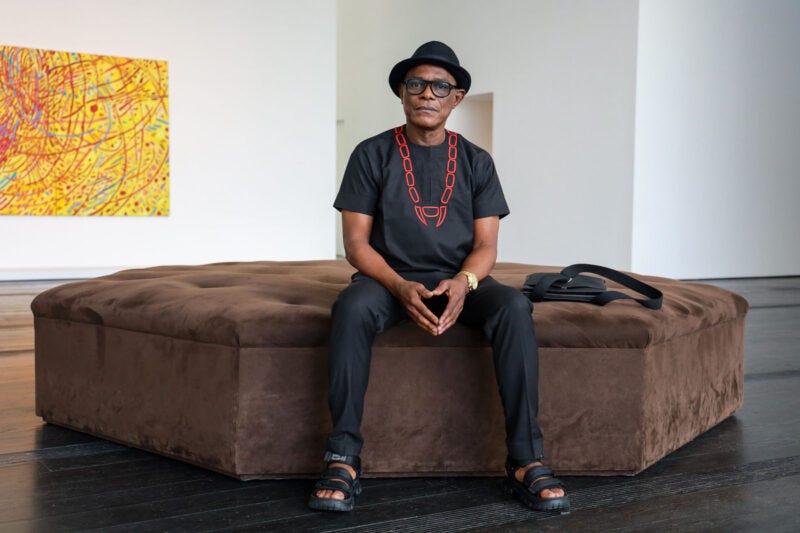
Of all the artists in Ideas of Africa, Samuel Fosso is perhaps the most quietly astonishing.
Born in Cameroon in 1962, Fosso opened a portrait studio in Bangui, Central African Republic, at the age of thirteen, having fled Biafra during the war. He began photographing himself in his studio after hours, wearing the clothes and assuming the poses of his customers, creating a body of self-portraiture that documented his own life as a young man finding himself in a turbulent world.
Then, in 2008, he made African Spirits: a series in which he became, in turn, Patrice Lumumba, Kwame Nkrumah, Leopold Senghor, Haile Selassie, Nelson Mandela, Malcolm X, Angela Davis, and Tommie Smith making his Black Power salute at the 1968 Mexico City Olympics. Each image is painstakingly researched and reconstructed. Fosso does not merely dress up. He inhabits. He studies the originals, replicates the lighting, the costume, the expression, and photographs himself as these figures with a fidelity that is both reverent and, in the best sense, presumptuous.
The series argues, simply and powerfully, that these figures belong to everyone of African descent: that their histories, their sacrifices, and their visions of a different world are a shared inheritance, not the property of a single nation or movement. Fosso is now based in Paris. He is 63 years old and has been making self-portraits for fifty years.
Deep Roots: Lagos Just Changed the Map
For years, the most persistent critique of the African art world has been this: the best works leave the continent. They end up in Basel, London, New York. The artists who make them gain international recognition, but the infrastructure to receive, protect, and present that work at home has lagged badly behind.
In 2026, Lagos began to answer that critique directly.
The Àkéte Collection, Nigeria’s first museum of modern and contemporary art, opened this year in Lagos. It is a landmark moment for a city that Artsy has now formally designated as a premier global art destination, and for a country whose art market has been one of the fastest growing on the continent. Arthouse Contemporary Lagos reported a total of ₦612 million in spring sales, and galleries across Victoria Island and Ikoyi are operating at a level of ambition and sophistication that rivals any city in the world.
Walk through Lagos right now and you will find: Duke Asidere’s major retrospective at Adegbola and Fresco Gallery on Victoria Island, surveying four decades of practice by one of Nigeria’s most rigorous painters, running through July 18. At Rele Gallery, Ugo Ahiakwo is transforming discarded vehicle parts and industrial fragments into sculptural forms that explore intimacy, fracture, and redemption. At SOTO Gallery, a duo exhibition uses the ancient technique of sgraffito, scratching through layered surfaces, to trace memory and Yoruba visual history through July 11. At DADA Gallery, which opened its permanent Lagos space in November 2025, three painters are pushing abstraction and figuration into new territory.
This is not a scene discovering itself. It is a scene that has been building for decades, led by pioneers like Nike Davies-Okundaye, whose Nike Art Gallery remains a five-storey testament to Nigerian craft and textile, and by galleries like Rele, kó, and Wunika Mukan, which have incubated artists who now headline museum shows in Paris and Los Angeles. What 2026 has added is institutional weight: a museum capable of anchoring that energy, keeping the best works at home, and telling the story of Nigerian modernism on Nigerian terms.
On the Global Stage: Who Gets Counted
Here is a number worth sitting with: the most recent Art Basel and UBS Survey of Global Collecting examined 10 markets in depth, including the United States, United Kingdom, China, France, Germany, Switzerland, Japan, Brazil, Singapore, and Hong Kong. Not a single African market was included.
This is not a small omission. The survey is the most influential annual study of collector behaviour in the world. Its findings shape how galleries price work, how auction houses target buyers, and how institutions plan acquisitions. To be absent from it is to be invisible in the data that drives the market.
And yet African collectors are among the most active and fastest-growing participants in the contemporary African art market. Auction houses in Lagos, Cape Town, and Nairobi are reporting strong results. Private collectors across the continent are building serious collections. The gap between the market’s reality and the market’s official story has rarely been wider.
Meanwhile, the Yale University Art Gallery rejected federal grants for an upcoming exhibition on the migration of Nguni peoples from southeastern Africa rather than comply with the Trump administration’s anti-DEI stipulations. Yale is funding the show from its own $46 billion endowment instead. It is a story about American cultural politics, but also about African art: an exhibition on African history caught in a funding battle over whether depicting that history constitutes ideological advocacy. The precedent is one with implications well beyond New Haven.
Museum Feature: Nike Art Gallery, Lagos
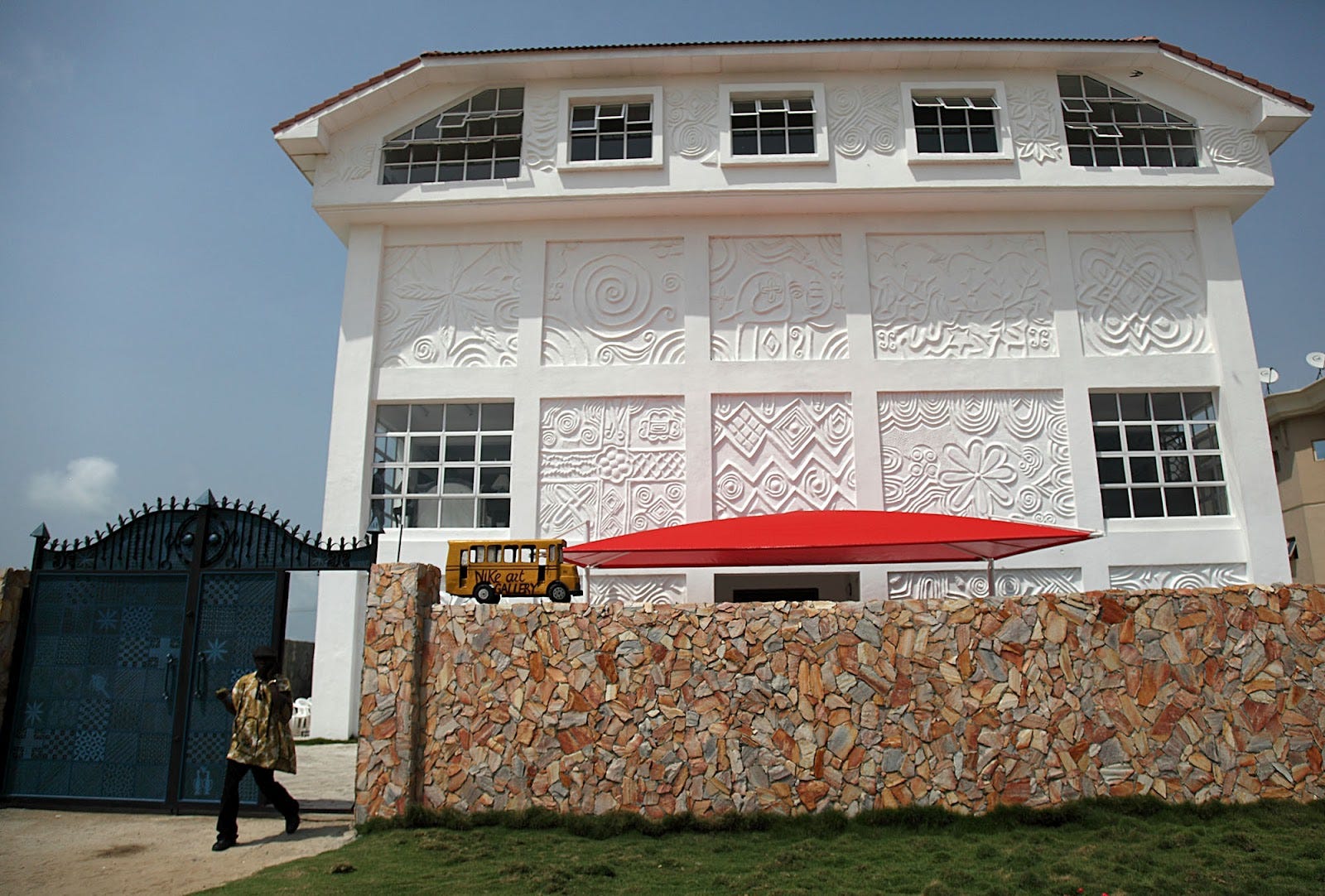
If you want to understand what Nigerian art looks like when it is fully, unapologetically itself, go to the Nike Art Gallery in Lagos.
Founded by Nike Davies-Okundaye, one of Nigeria’s most celebrated textile artists and a recipient of the national honour of Member of the Order of the Niger, the gallery spans five floors in the Lekki district and houses one of the most extensive collections of Nigerian art, craft, and textile in existence. It is not a white cube. It is a living, breathing archive: walls covered with paintings by artists across generations, rooms filled with hand-dyed adire cloth, beadwork, woodcarving, and ceramics. Entry is free.
Davies-Okundaye has spent decades teaching traditional Yoruba textile techniques to young women and men who would otherwise have no access to formal arts education. The gallery is as much a school and a community as it is an exhibition space. It is, in the truest sense, infrastructure: the kind that supports artists long before the international market discovers them, and continues to support them regardless of whether it ever does.
At a moment when Lagos is asserting itself as a global art capital, the Nike Art Gallery is a reminder of what made that possible: not the art fairs or the auction results, but the patient, unglamorous work of building something lasting from the ground up.
Nike Art Gallery, 2 Elegushi Road, Lekki, Lagos. nikegallery.com
Want to explore more institutions across the continent? Africa.com’s Museums of Africa guide is your country-by-country companion to heritage collections, contemporary art spaces, and cultural institutions from Cairo to Cape Town. Explore the full guide at africa.com
A Final Word
MoMA is showing African portraiture for the first time in eighty years. Lagos just opened its first museum of modern art. The world’s most influential collector survey still does not include a single African market.
All three of these facts are true at the same time. That tension, between recognition and omission, between the art world opening up and the data failing to keep pace, is where the most important conversations in African art are happening right now.
We will keep having them.