
On Presence, Power, and the Places That Could Not Ignore Them

From a medieval square in Basel to a presidential lobby in Chicago, a new era announces itself.
The Art of African Vision is produced by Africa.com. For too long, African art has been a footnote in someone else’s story. This newsletter puts it at the centre. Issue by issue, we move through the studios, streets, galleries, and public squares where African and diaspora artists are doing the most urgent creative work in the world today: from the bronze casters of Benin City to the digital painters reimagining Nairobi, from the textile artists of Accra to the artists filling the great squares and lobbies of Basel, London, and Chicago. This week, that work is impossible to ignore. So are we.
African Artists Are Everywhere
There are moments when the art world seems to shift, not gradually but all at once, and you realise that something has changed for good.
This is one of those moments.
This week, a Ghanaian artist is installing a monumental new work in the heart of Basel, Switzerland, in front of a medieval cathedral, during the most commercially significant art fair on the planet. This week, a Nigerian-American artist’s portrait of Barack and Michelle Obama is being unveiled at the Obama Presidential Center in Chicago. This week, Africa Basel, a dedicated platform for contemporary African art, opens its second edition in a listed industrial building just minutes from Art Basel itself.
None of this is coincidence. It is the result of decades of work by artists, curators, gallerists, and collectors who refused to accept that African art belonged at the margins of the global conversation. What is happening this week in Basel and Chicago is a reckoning arriving in plain sight.
We are here to make sure you see it.
Artist Spotlight: Ibrahim Mahama, The Weight of Things
There is a work going up right now on the Münsterplatz in Basel, in the shadow of a 12th-century cathedral, in the centre of one of the most prosperous cities in one of the wealthiest countries in the world.
It is made of rubber. Industrial rubber remnants sourced from a factory in Ghana, a factory built after independence, in the optimistic years when the new nation believed that industrialisation would deliver what colonialism had taken away. The rubber is old now, discarded, shaped by the labour of workers whose names nobody recorded. Ibrahim Mahama has gathered it, suspended it, and turned it into something that asks you to stand still and think about what things cost, and who pays.
The work is called The God of Small Things (2026), and it is Mahama’s commission for Art Basel’s inaugural Gold Award in the Established Artist category. That a Ghanaian artist holds this honour is not incidental context. Last year, Mahama was ranked number one in the Art Review Power 100, the definitive annual list of the most influential figures in the contemporary art world. He was the first African artist ever to reach the top. The Münsterplatz commission is, in part, the art world acting on that recognition. The Münsterplatz is not a gallery. It is not a designated art space. It is a public square where ordinary people walk to work, eat lunch, take their children. Mahama’s work does not ask permission to be there. It simply arrives, enormous and unignorable, made of the materials of labour and history and African independence, in the middle of Europe’s art market week.
Mahama has been making work like this for years. His practice centres on jute sacks: the rough, utilitarian bags used to transport cocoa and other commodities across Ghana and West Africa, the same bags that have carried the wealth of the continent into the hands of others for generations. He collects them from labourers, sews them together into vast textile installations, and drapes them over buildings, scaffolding, and public structures. The effect is both beautiful and unsettling: a familiar building suddenly wearing the skin of global trade, made strange by the material that covers it.
The God of Small Things continues this inquiry but takes it further. Rubber from an independence-era factory, transformed into art in the square of a medieval European city, during the week when the world’s wealthiest art collectors gather a short walk away. Every element of that sentence is doing work.
Mahama has said that he is interested in the lives of objects: where they come from, who touched them, what systems of power they passed through before arriving wherever they are now. Standing in front of his Basel installation this week, those questions are impossible to avoid.
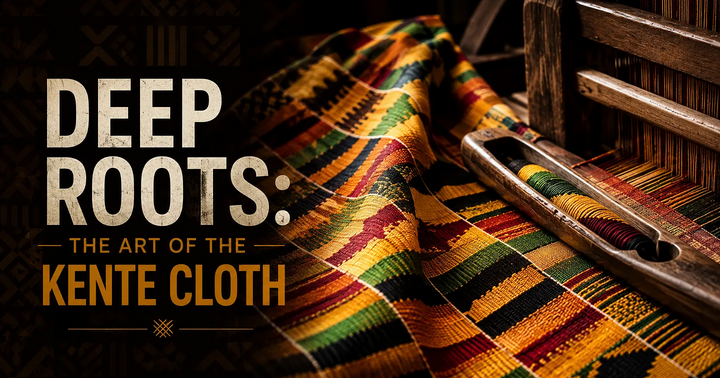
The Art of the Kente Cloth
To understand Ibrahim Mahama’s relationship with fabric and labour, it helps to understand where that relationship comes from.
Kente cloth is one of the most recognisable textile traditions in the world. Originating among the Asante and Ewe peoples of Ghana, it is woven on narrow strip looms, the strips then sewn together into larger cloths worn at ceremonies and moments of social significance. The colours and patterns are not decorative alone. Each combination carries specific meaning: gold for royalty and wealth, green for growth and renewal, black for spiritual maturity and the ancestors. A kente cloth is a text as much as it is a textile.
The craft was historically reserved for royalty. The Asantehene, the king of the Asante people, would commission specific patterns that could not be replicated without permission. Over time, kente became a symbol of African pride more broadly, worn across the diaspora at graduations and ceremonies as a declaration of heritage and dignity.
Today, Ghanaian weavers work on both handlooms and power looms, producing cloth for local markets, diaspora buyers, and international fashion houses. The tension between the handmade and the mechanised, between cultural tradition and global commerce, runs through contemporary kente production in ways that mirror the tensions in Mahama’s own work. The loom and the factory are not so far apart.
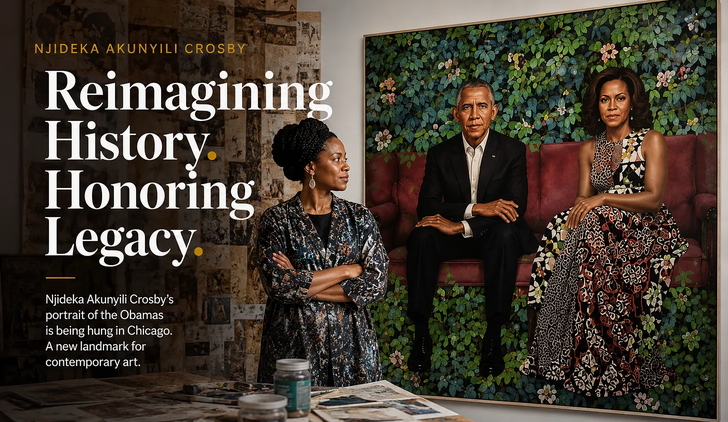
On the Global Stage: Njideka Akunyili Crosby and the Obama Portrait
This week, a painting by a Nigerian-American artist is being unveiled in Chicago that will be seen by every visitor to the Obama Presidential Center for as long as the centre stands.
Njideka Akunyili Crosby, born in Enugu, Nigeria in 1983, has been commissioned to create the first official portrait of President Barack Obama and First Lady Michelle Obama for the Obama Presidential Center, which opens on Thursday, June 19, chosen deliberately to coincide with Juneteenth. The centre, located in Chicago’s Jackson Park, cost $850 million to build and features more than 28 site-specific installations by 30 artists. Akunyili Crosby’s portrait will hang in the main lobby, the first image every visitor sees.
Akunyili Crosby’s practice is built on layering: painted figures over photographic transfers drawn from Nigerian magazines, family albums, and personal archives, creating compositions that hold multiple times, places, and cultural registers simultaneously. A figure in one of her paintings is always in more than one world at once: present in the room she inhabits, but also in memory, in history, in the cultural fabric of a diasporic life stretched between Nigeria and America.
That sensibility is precisely right for a portrait of the Obamas. Their story is also a story of multiple worlds held together: of American political history and African heritage, of the South Side of Chicago and the steps of the Capitol, of what was and what was fought for and what became possible. Akunyili Crosby’s layered, transfer-rich approach will weave those threads together in ways that a conventional painted portrait never could.
At Frieze Los Angeles earlier this year, a work by Akunyili Crosby sold for $2.8 million, the fair’s leading sale. She is among the most significant painters working anywhere in the world today. That her first official portrait commission of a US president goes to a Nigerian-born artist is a statement in itself, and one that will outlast any art fair or biennale opening.
Museum Feature: Goodman Gallery, Johannesburg and London
Not every institution that matters is a museum. Some of the most important work in the African art world is being done by galleries: commercial spaces that take curatorial and financial risks on artists whose work the wider market has not yet caught up with.
The Goodman Gallery, founded in Johannesburg in 1966, is one of the most significant of these. For nearly six decades, through apartheid and its aftermath, through the global art market’s long indifference to African contemporary art and its sudden enthusiasm for it, the Goodman has held its ground. It represents some of the most important artists on the continent: William Kentridge, whose animated drawings and theatre works have made him one of the most celebrated artists in the world; Zanele Muholi, whose portraits we explored in Issue 2; and a roster of younger South African, Nigerian, Kenyan, and Zimbabwean artists whose work is reshaping what the global art world pays attention to.
The gallery now has spaces in London and New York as well as Johannesburg, and is represented at Art Basel. It has never abandoned its original mandate: to make the case, in the most commercially demanding rooms in the world, that African artists belong there.
That is a form of advocacy, and it deserves to be called one.
Goodman Gallery, 163 Jan Smuts Avenue, Johannesburg. goodman-gallery.com
Want to explore more institutions across the continent? Africa.com’s Museums of Africa guide is your country-by-country companion to heritage collections, contemporary art spaces, and cultural institutions from Cairo to Cape Town. Explore the full guide at africa.com
A Final Word
Ibrahim Mahama’s rubber installation is standing in Basel right now. Njideka Akunyili Crosby’s portrait of the Obamas is being hung in Chicago right now. Africa Basel opened its doors this week, two minutes’ walk from the most powerful art fair in the world.
Right now is a good time to be paying attention.