
On The Beautiful Game, Pan-Africanism, and a Market Finding Its Footing

Fifty artists in Miami. Three hundred works in London. One number that tells you where the market really stands.
The Art of African Vision is produced by cms.africa.com/. Africa's story has long been told in fragments, scattered across collections and institutions that rarely speak to one another. This newsletter exists to put the pieces back in conversation. Every issue, we follow African and diaspora creativity wherever it surfaces: on the walls of a converted community centre during the World Cup, in major museum exhibitions, in the cold arithmetic of auction results. The story is bigger than any one frame. We are here to hold the whole of it.
The Beautiful Game, Reimagined
A few miles from the FIFA World Cup stadiums in Miami, in a converted community centre in North Miami, a different kind of tournament is taking place. No referees, no scoreboard. Just paint, photography, sculpture, and a single, shared subject: football, and what it has meant to Africa and the African diaspora.
Art and the Beautiful Game: Africa on the World Stage, curated by Alfonso D. Brooks of the AfriKin Foundation, brings together more than 50 artists from over 25 nations and territories across Global Africa and the Black world. Brooks spent six months assembling the show, which opened ahead of kickoff and runs throughout the tournament. Every one of the ten African nations competing is represented, with a dedicated tribute to Cape Verde, the small island nation making its World Cup debut and stunning the football world with a draw against Spain in its opening match.
What makes the exhibition more than a celebration of national pride is a category Brooks calls “Hidden Africa”: teams like France, Belgium, and England, whose rosters are filled with players of African heritage, born or developed in Europe, carrying the continent’s talent into jerseys that are not African at all. The exhibition does not resolve that tension. It sits inside it, asking questions about belonging, migration, and who gets to claim an athlete’s success as their own.
It is, in its way, the same question this newsletter keeps returning to about art itself. Whose story is this? For three weeks in Miami, with tens of thousands of football fans passing through the city, that question is being asked through a header, a goal celebration, a flag held high in a stadium far from home. Few exhibitions get to make their argument in front of an audience this large, this distracted, and this primed to feel something.
A Planet, Imagined in Black
On June 11, the Barbican Art Gallery in London opened the doors to something that has never quite existed before: a major museum exhibition dedicated entirely to the visual and cultural legacy of Pan-Africanism.
Project a Black Planet: The Art and Culture of Panafrica brings together more than 300 works spanning over a century, from painting and sculpture to film, journals, posters, and archival material, produced across Africa, Brazil, the Caribbean, North America, and Europe. Co-organised with the Art Institute of Chicago and MACBA in Barcelona, it runs through September 6 as the centrepiece of the Barbican’s wider summer season, which adds more than fifty additional events: concerts, film screenings, talks, and workshops exploring how Pan-African ideas have shaped art, music, and political imagination across the twentieth century and into the present.
Pan-Africanism has long been understood as a political philosophy: a call for solidarity among people of African descent, a challenge to colonial rule, an argument for self-determination. What this exhibition does, for the first time at this scale, is treat it as an aesthetic force in its own right. It asks what Pan-Africanism looked like, what visual language artists built to express transnational Black solidarity, and how that language travelled between Lagos, Havana, Kingston, Harlem, and London.
This is the kind of exhibition that does not come along often: ambitious in scope, serious in scholarship, and unmistakably positioned as a flagship rather than a side gallery show. The fact that it has landed at one of London’s most significant cultural institutions, co-organised with two major American and European museums, signals something about where the conversation around African and diaspora art now sits in the world’s major cultural capitals. Not at the margins. At the centre of the programme.
Artist Spotlight: Magdalene Odundo, The Body in Clay
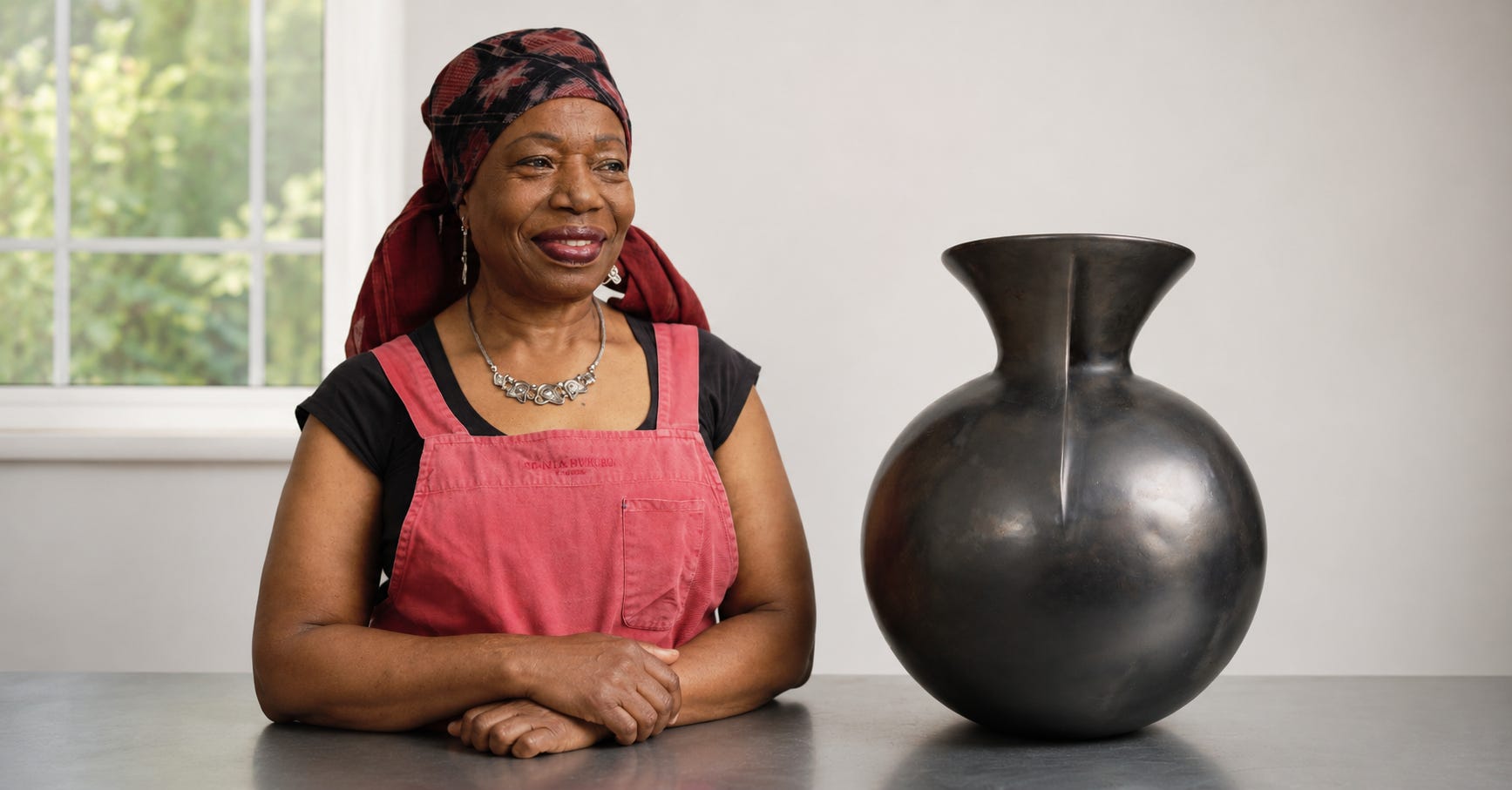
Among the more than 300 works in Project a Black Planet sits a single ceramic vessel by Dame Magdalene Odundo, worth slowing down for.
Odundo was born in Nairobi in 1950 and trained initially as a graphic artist before moving to England in 1971. She studied ceramics at the Royal College of Art, but it was her decision to return to Kenya and Nigeria as a young artist, to study hand-building and firing techniques at the Abuja Pottery and with women potters working centuries-old traditions, that shaped the practice for which she is now celebrated.
Her vessels are built entirely by hand, coiled rather than thrown, scraped smooth with a gourd, burnished, then fired twice: once oxidising, turning the clay deep red-orange, and again oxygen-poor, pulling it toward black. No glaze, no wheel, just clay, fire, and extraordinary patience. The forms are asymmetrical, swelling in ways that evoke the human body, drawing on a lineage of pottery-making across sub-Saharan Africa historically associated with women, even as Odundo positions her vessels as sculpture rather than utility.
Her work resists easy categorisation, drawing on Kenyan and Nigerian pottery traditions, British studio ceramics, and forms studied across Greek, Chinese, and Aztec art history. That refusal to sit neatly in one tradition is its own Pan-African gesture: an insistence that African forms belong in conversation with the whole of global art history.
She was made a Dame Commander of the British Empire for services to the arts. Her vessels sit in the permanent collections of the Victoria and Albert Museum, the Metropolitan Museum of Art, and the Smithsonian. Still, each one begins the same way it always has: with her hands, a coil of clay, and a memory of women working the same way generations before her.
On the Global Stage: What the Numbers Actually Say
Here is a number worth sitting with: auction sales of work by African artists totalled $70.5 million globally in 2025, a 43 percent increase from the previous year.
That sounds like unambiguous good news. In part, it is. But the figure remains well below the 2022 peak of $116.5 million, and dealers describe a market that remains, in their own words, under pressure. Growth is real. It is also uneven and concentrated in particular artists and cities rather than spread across the continent.
Meanwhile, the centre of gravity for where African art gets shown and discussed has been shifting visibly this year. In May, Strauss and Co., South Africa’s leading auction house, co-hosted the fifth African Art in Venice Forum alongside the Smithsonian National Museum of African Art during the Biennale’s opening week, the latest sign of growing institutional investment in conversations around African art rather than just its sale. Strauss itself posted record results for 2025: R475.5 million ($28 million) in total sales, up 26 percent on the previous year, with 14 individual works selling above R5 million. At the same time, interest from collectors in the Middle East is intensifying, with fairs in Doha increasingly competing with Marrakech’s long-running 1:54 Contemporary African Art Fair for attention and capital.
None of this resolves the deeper question this newsletter keeps returning to: who gets to set the value of African art, and on what terms. But it does tell us the conversation is shifting, geographically and institutionally, in real time.
Museum Feature: Museum of the African Diaspora, San Francisco
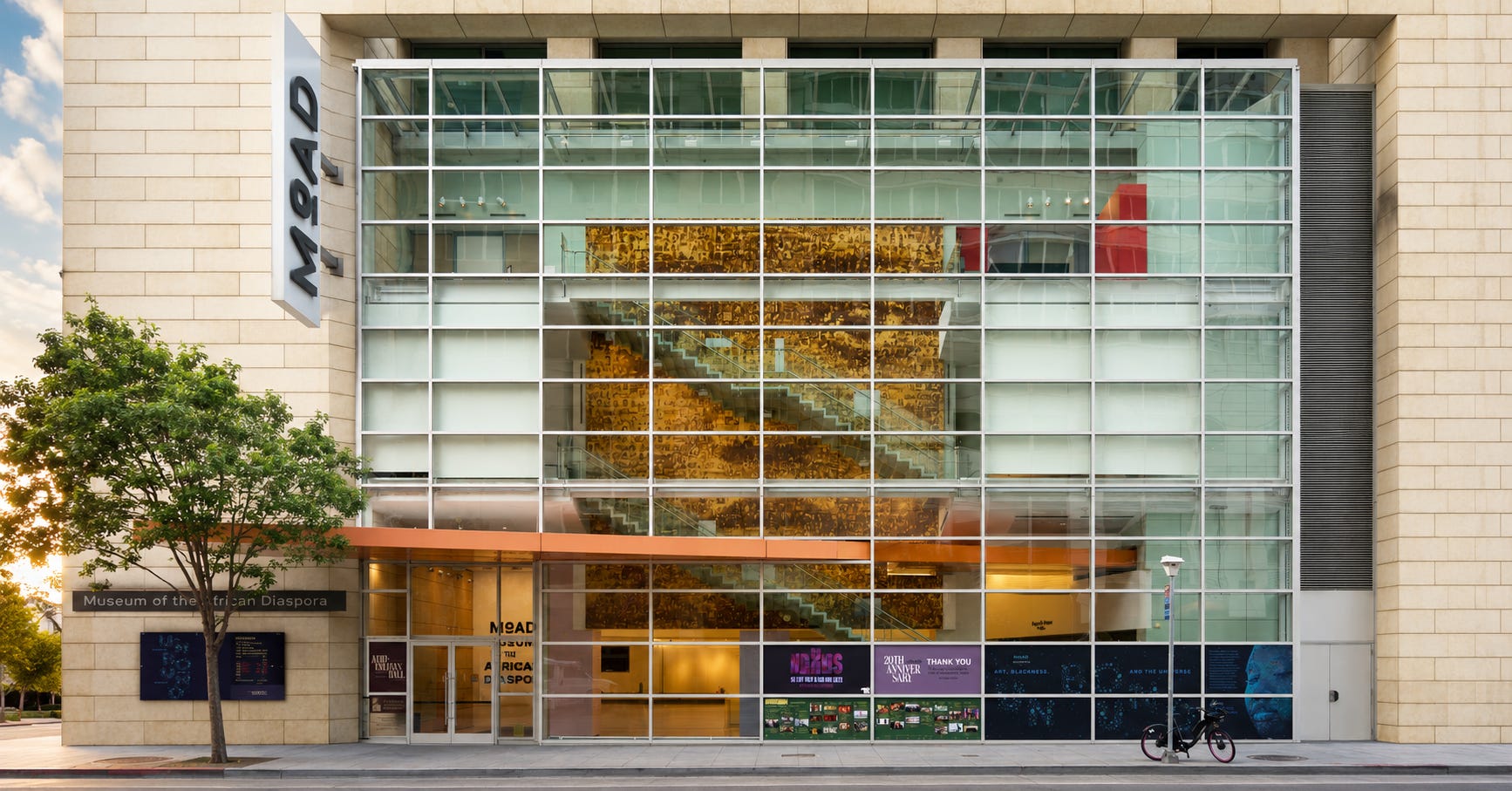
San Francisco’s Museum of the African Diaspora, known as MoAD, has spent more than two decades making the case that the African diaspora is not a footnote to African art history, but a central, living part of it.
Currently on view through August is Unbound: Art, Blackness, and the Universe, an exhibition exploring Black cosmology, speculative thinking, and expansive ideas of identity, themes that sit comfortably alongside the questions raised by Art and the Beautiful Game in Miami this same month. Both exhibitions, in their own ways, ask what it means to belong to more than one place at once, and what gets made when artists refuse to choose.
MoAD places the diaspora itself, rather than the continent alone, at the centre of its programming. That distinction matters. A museum dedicated to the diaspora is making an argument: that Brazil, Haiti, the American South, and the banlieues of Paris are not peripheral to the African story. They are part of how that story keeps being written.
Museum of the African Diaspora, 685 Mission Street, San Francisco. moadsf.org
Want to explore institutions across the continent? cms.africa.com/’s Museums of Africa guide is your country-by-country companion to heritage collections, contemporary art spaces, and cultural institutions from Cairo to Cape Town. Explore the full guide at cms.africa.com/
Reader Discovery: Musah Mwakelemu
→This section is new, and it exists because a reader wrote in.
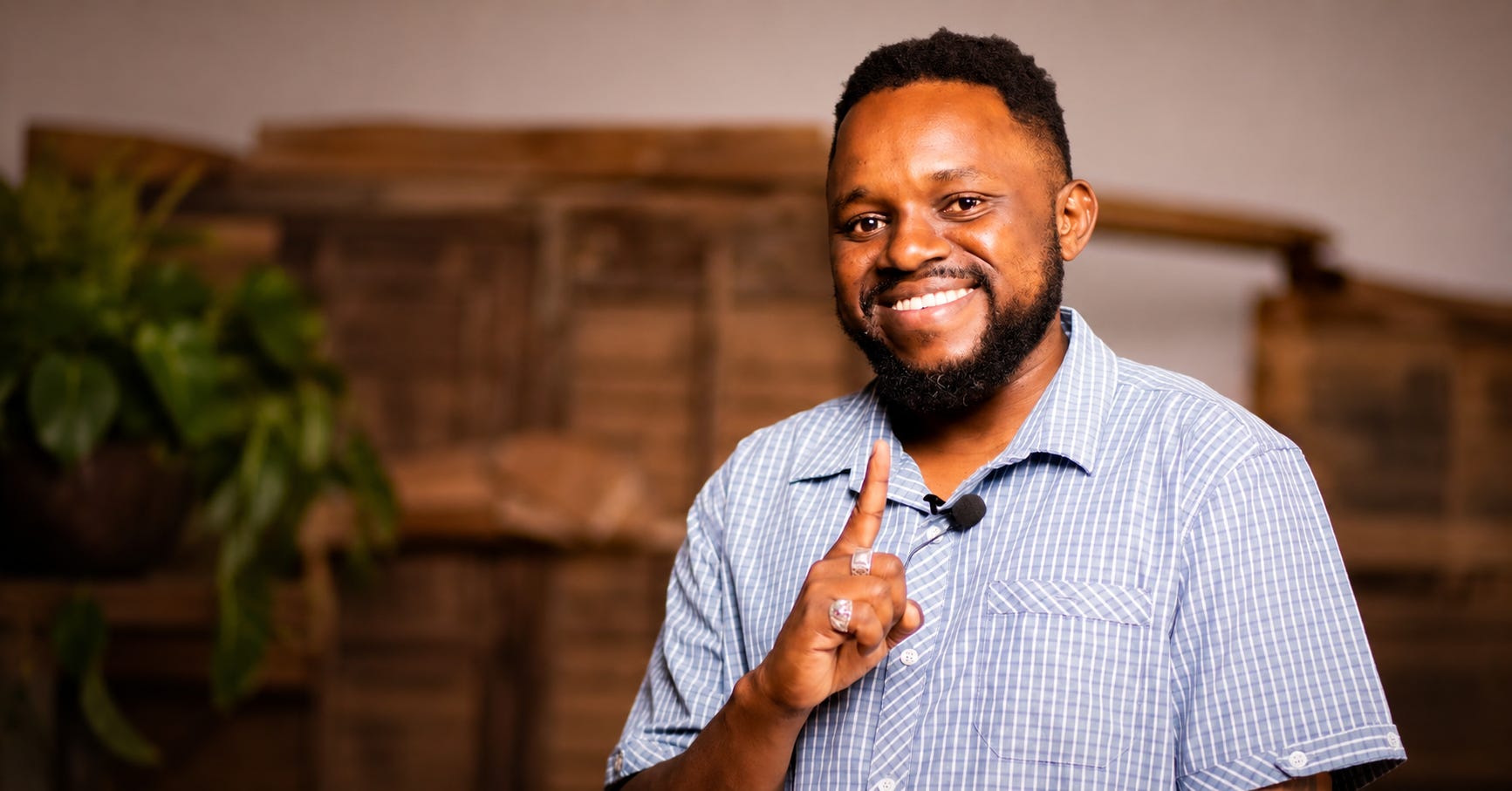
Musah Mwakelemu is a multidisciplinary contemporary artist based in Nairobi, originally from Mombasa. He is self-taught, having sharpened his practice under painter Patrick Mukabi at Dust Depo Studio after studying commerce and law, and he became a full-time artist in 2016. His work moves between cartoon and symbolism, addressing power, identity, consciousness, justice, culture, and race, often through pointed political imagery: a 2016 piece titled “The Corporate Ladder” used acrylics, markers, and his own degree certificate to capture the frustration of unemployed graduates in Kenya. He held his first solo exhibition at the Fort Jesus museum in Mombasa, and has since shown work in group exhibitions in Nairobi, including at Karen Village and Kemet Arts Gallery. He describes himself simply: he tries to capture the motion and emotion of social and cultural issues.
The reader who submitted his name also told us that Mwakelemu led a salvage and restoration project for one of Mombasa’s oldest churches, in collaboration with the Karen Village arts and culture centre. We were not able to independently confirm the details of that project before publishing this issue, and we want to be straightforward about that rather than present it as verified fact. If you know more, or if you are Musah, we would love to hear from you directly.
This is exactly the kind of story this newsletter wants more of: artists working seriously, often without major gallery representation or international press, whose work deserves a wider audience. Send us the names you think we are missing.
A Final Word
This week, a header on a soccer pitch and a brushstroke on a canvas in North Miami are telling the same story from two different angles. An exhibition in London asks what solidarity looks like when it is painted, sculpted, and filmed. A market slowly, unevenly, learns to value what it spent a century undervaluing.
None of these stories is finished. None of them resolves neatly. But each of them is moving in the same direction: toward a world where African art tells its own story, on its own terms, to whoever is ready to listen.
We will keep listening too.
Topics