
The IMF Is Back in Dakar. Africa’s Sovereign Markets Are Open for Business

Senegal signals credibility with a $104 million early payment, the DRC prints its first Eurobond four times oversubscribed, and Kenya’s streets are sending governments a clear message on the cost of the time.
The IMF landed in Dakar on June 15 after a four-month absence. Senegal paid $104 million in Eurobond coupons early to make sure the visit happened. The DRC raised $1.25 billion in its first-ever sovereign bond, four times oversubscribed, by selling the US critical minerals partnership as its credit story. Nigeria’s tax reforms are hitting their numbers. And Kenya recorded 94 fuel demonstrations in a single month. Africa’s sovereign markets are reopening. Its reforms are producing results. And its citizens are telling governments exactly what the energy crisis costs.
Lead Story »
The IMF Is Back in Dakar. Senegal Paid $104 Million Early to Prove It Belongs There.
The mission is introductory, not substantive. But its arrival, and the $104 million Senegal paid before it landed, are the clearest signals yet that Dakar understands the stakes.
IMF mission chief Mercedes Vera Martin arrived in Dakar on June 15, restarting engagement after the four-month pause triggered by the Sonko dismissal. The visit is introductory: formal talks require consolidated, audited debt data that Senegal has not yet fully provided. But before the mission landed, Dakar made early repayments on two Eurobond coupons totalling $104 million, a deliberate signal of debt service capacity to bond markets.
The backdrop remains difficult. Senegal’s public debt reached 132% of GDP after the discovery of previously undisclosed borrowings. The IMF suspended a $1.8 billion support programme pending full debt clarification. Finance Minister Cheikh Diba, retained through the political transition, has been the continuity figure for international creditors. PASTEF, controlling 130 of 165 National Assembly seats under Sonko, remains the legislative obstacle to any reform package requiring parliamentary approval. The June 30 target for a broad programme agreement, flagged in previous editions, has quietly been allowed to slip. Markets are now watching for whether the mission produces a clear timeline for formal talks rather than an agreement itself.

Why It Matters: The early coupon payments are the clearest signal yet that the Faye government understands the difference between political positioning and market credibility. Paying early when you are cash-constrained is expensive; it is also the most direct message available to bond markets. For investors holding Senegalese sovereign debt, the arrival of the IMF mission and the voluntary coupon prepayment reduce the near-term default risk premium. The medium-term risk remains: any programme requires legislative action that Sonko controls. The path forward runs through a political negotiation that has not yet happened. Watch whether the Faye government uses the IMF visit to create the conditions for that negotiation, or whether it settles for optics over substance.
This Week »
Capital Markets · DRC
The DRC Sold Its First Sovereign Bond Ever. It Used the US Minerals Partnership as the Credit Story. It Worked.
The DRC raised $1.25 billion in its debut sovereign Eurobond in April, the first African sovereign Eurobond debut since 2019. Orders exceeded $5.2 billion across more than 110 global investors, more than four times oversubscribed. The deal: a five-year tranche at 8.75% and a ten-year tranche at 9.5%, listed on the London Stock Exchange. What sold it was the US critical minerals partnership. At roadshows in New York, London, and Paris, Kinshasa presented its minerals deal with Washington. Analysts noted investors viewed heavy US company investment in DRC mining as significantly facilitating claims in the event of a default. The DRC’s low debt ratio of around 20% of GDP and its cobalt and copper reserves were the other pillars. Proceeds go to infrastructure: a Kinshasa airport terminal, roads, and a hydroelectric power plant. Transparency questions on fund use remain. But for a country long treated as uninvestable, four-times oversubscription is a structural milestone.
Fiscal Policy · Nigeria
Nigeria’s Tax Reforms Are Hitting Their Numbers. N2.42 Trillion in VAT and Counting.
Nigeria’s VAT revenue reached N2.42 trillion in the first half of 2026, a significant increase driven by the Tinubu administration’s tax reform agenda, which has broadened the VAT base, reduced exemptions, and strengthened collections enforcement through FIRS. The figure is ahead of targets and represents one of the clearest data points that Nigeria’s structural reforms are producing fiscal results rather than just policy announcements. Combined with the CBN’s exchange rate unification and the Dangote refinery’s impact on fuel import costs, the VAT performance strengthens the government’s hand in presenting a credible fiscal consolidation story to investors. The revenue gain also reduces pressure on domestic borrowing and creates more headroom to fund infrastructure without crowding out private credit. For investors tracking Nigerian sovereign risk, improving fiscal data is the most important near-term variable after the Dangote IPO subscription window.
Political Risk · Kenya
Kenya Had 94 Fuel Demonstrations in May. The Finance Bill Is Next.
Kenya recorded 94 fuel-related demonstrations in May, the largest spike since the Hormuz blockade took effect in April, per ACLED. Public service vehicle operators led road blockades, motorway bonfires, and clashes with security forces. The government cut diesel by KSh10 in June but reduced petrol by only KSh0.22, a response widely seen as insufficient. Finance Bill 2026 is now before parliament. Last year’s equivalent bill triggered the Gen-Z protests that forced Ruto to withdraw it entirely. This year’s version lands against a backdrop of record fuel prices and 94 demonstrations already on the books. The political combustibility is real. Watch the Finance Bill debate this week.
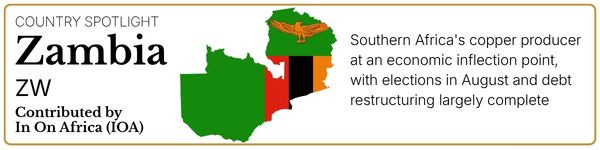
Zambia enters the second half of 2026 in a more stable position than at any point since its 2020 sovereign default. The country completed its Eurobond debt restructuring in late 2023 and has since maintained an IMF-supported programme, with fiscal consolidation broadly on track. Copper production is rising: Zambia produced approximately 780,000 tonnes in 2025 and is targeting over 800,000 tonnes in 2026, benefiting from new investment at First Quantum’s Kansanshi mine, Barrick’s Lumwana operation, and several smaller producers. The Lobito Corridor, when complete, will transform Zambia’s mineral export logistics, reducing dependence on the longer southern route through Zimbabwe and South Africa. The ZCCM Investment Holdings restructuring is ongoing, and the government has signalled interest in greater state participation in new mining projects, consistent with the resource sovereignty trend across the continent.
The August 2026 election is the primary near-term risk. President Hichilema’s UPND government has delivered economic stabilisation and the debt restructuring but has struggled to translate macro gains into visible improvements in living standards. Chatham House notes intensifying social pressures from the failure of macroeconomic stabilisation to reach ordinary Zambians. An opposition upset, while currently not the base case, would create policy uncertainty for mining investors and could complicate the IMF programme relationship. The operating environment outside the political cycle is broadly improving: investor protections have been strengthened, the Zambia Revenue Authority has modernised collections, and the legal system offers reasonable commercial dispute resolution.
Opportunities: Copper and cobalt mining and processing, mining services, Lobito Corridor logistics and trade finance once operational, renewable energy including solar and hydropower, agri-processing in a country with significant arable land and low population density, and financial services for a growing mining workforce.
Risks: August 2026 election creates policy uncertainty for mining investors. Resource nationalism on new mining projects is a stated government preference. Electricity supply constraints continue to affect industrial operations. Kwacha volatility remains a FX management risk. Infrastructure gaps outside the Copperbelt and Lusaka corridors are significant.
Operating Tips: English is the language of business and government. Lusaka is the commercial hub; Ndola and Kitwe anchor the Copperbelt. Community relations investment is essential for mining operations: Zambia has a long history of organised mining labour and community engagement expectations are high. Register with the Zambia Development Agency early for large investment approvals. Build in election-cycle risk buffers for any decision-making timelines running through August.
Country intelligence sourced from the cms.africa.com/ Doing Business in Africa series. Read the full Zambia profile, including IOA’s research analysis.
In Brief »
- Pan-African · Digital Economy» cms.africa.com/ published a major analysis today arguing that Africa is no longer catching up digitally: it is rewriting the rules of digital growth. The piece documents how mobile-first infrastructure, fintech innovation, and AI adoption are creating African-specific digital models that are attracting global capital and talent. Required reading for executives assessing Africa’s digital investment landscape. Read on cms.africa.com/
- Ghana / Cote d’Ivoire · Trade» Ghana and Cote d’Ivoire agreed to harmonise cocoa farm-gate pricing policies at their High-Level Summit on the Future of the Cocoa Economy in Abidjan on June 16, signed by Presidents Mahama and Ouattara. The deal aligns crop calendars starting September 2026 and commits both countries to price coordination to reduce cross-border smuggling and improve farmer incomes. Plans to expand the initiative to other African cocoa-producing nations were also announced, strengthening the continent’s collective bargaining power with international buyers. Source: Graphic Online
- Kenya · Infrastructure» Kenya contracted TDB and AFC on June 19 to arrange $1.2 billion in financing for Jomo Kenyatta International Airport’s expansion, targeting a tripling of annual passenger capacity from 7.5 million to 22 million. The project, paused after the Adani cancellation in 2024, is back on track with a revenue-backed financing structure that crowds in DFIs and commercial banks. For Nairobi’s ambition to remain East Africa’s aviation hub against expanding competition from Addis Ababa, Kigali, and Gulf airports, this investment is not optional. Source: CNBC Africa
- Nigeria · Capital Markets» Femi Otedola acquired 680 million First HoldCo shares through the group’s N45 billion private placement at N44 per share, lifting his stake to 20.42% and making him the largest individual shareholder in any Nigerian banking group. The acquisition came as First HoldCo reported Q1 2026 profit before tax of N321 billion, up 72% year-on-year, with a 31.6% return on equity that leads all five of Nigeria’s largest banks. Otedola has separately disclosed plans to invest $100 million in the Dangote refinery IPO. Source: Nairametrics
- Zimbabwe · Lithium» Zimbabwe lithium producers have formally requested more time from the government to complete mandatory beneficiation plants before export restrictions take effect. Processing capacity takes years and capital to build, and blanket export bans before that capacity exists choke revenue rather than add value. The debate mirrors the DRC’s lithium royalty reclassification and Ghana’s gold offtake demands: resource sovereignty is the direction, but the implementation gap between policy and industrial reality is creating friction across the continent’s mining sector. Source: Ecofin Agency
What Investors Should Watch »
- Senegal IMF Mission Outcomes → Watch for any statement from the Vera Martin mission on a timeline for formal programme negotiations. A clear roadmap, even without a deal, would stabilise Senegal’s sovereign risk pricing. Silence or vague language keeps the uncertainty premium in place and increases pressure on Eurobond spreads heading into Q3.
- Zambia Election · August 2026 → The election is six weeks away. Mining investors with Zambia exposure should be stress-testing their assumptions against an opposition scenario. UPND’s macro record is strong; the political risk is in the disconnect between GDP growth and lived experience. Watch poll data and civil society signals through July.
- Kenya Finance Bill 2026 → Parliament is debating Finance Bill 2026 this week. Last year’s equivalent bill triggered the Gen-Z protests that forced Ruto to withdraw it. This year’s version arrives against a backdrop of record fuel prices and 94 fuel demonstrations. Any repeat of last year’s street-level resistance would have direct implications for political stability and investor confidence in Kenya heading into H2 2026.