Cybercrime is no longer a distant threat absorbed by wealthy economies with the resources to absorb it. It has moved — quietly, deliberately — into the fastest-growing digital markets on earth. And in Africa, where connectivity is expanding faster than the safeguards around it, the cost is beginning to show.
The Cost of Getting Connected
Samuel didn’t think twice when the message arrived — a notification from his bank, familiar logo, urgent tone. The Lagos-based logistics manager clicked the link, entered his credentials, and within minutes, watched his savings account drain to zero. He filed a report. He got a case number. He never got his money back.
His story is not remarkable. That is precisely the point.
Across sub-Saharan Africa, a quiet collision is underway — between the speed of digital adoption and the infrastructure needed to protect it. As millions of Nigerians and South Africans join the formal digital economy for the first time, opening mobile wallets, conducting business on fintech platforms, and moving money across borders with a tap, another ecosystem is expanding in parallel, one built on deception, urgency, and the cracks in systems still finding their footing.
The Numbers Behind the Noise
Last year, the US Federal Bureau of Investigation released data showing that South Africa ranked 12th and Nigeria 14th globally for cybercrime complaints — the only two sub-Saharan African nations to appear in the top 20. It was a striking finding — not because of the volume, which remained lower than complaints filed from top-ranked countries like Canada, India, and Japan — but because of what their placement signals.
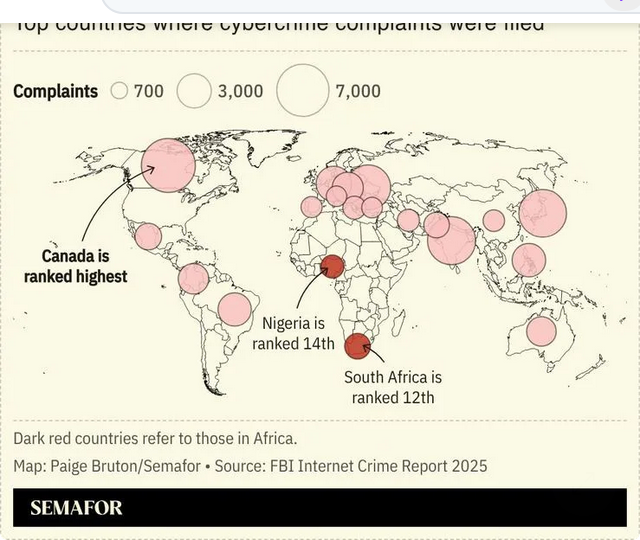
To understand the full weight of those rankings, consider the company they keep. The countries clustered above them on that list are, almost without exception, large, mature digital economies with decades of internet infrastructure behind them. South Africa and Nigeria arrived in that ranking not from a position of long-established connectivity, but from one of rapid acceleration. That distinction matters enormously.
Global cybercrime losses reached a record $20.8 billion in 2025, a 26% surge from the previous year, with more than one million complaints filed worldwide. For two economies that together represent the largest share of sub-Saharan Africa’s GDP, appearing on that list is less an indictment than a mirror. Their inclusion points to a growing exposure tied to expanding digital and financial ecosystems — the very things working, mobile banking penetration, e-commerce growth, fintech investment, are also the things creating new surfaces for attack. The more connected a population becomes, the more it is worth targeting.
There is another layer to this story. In October, both Nigeria and South Africa were removed from the Financial Action Task Force’s grey list, the global financial crime watchlist that had shadowed their international transactions and investor reputations for years. The delisting was hard-won: it required demonstrating progress on anti-money laundering frameworks, prosecution capacity, and regulatory coordination. That achievement now sits in uncomfortable tension with rising cybercrime exposure — two data points pointing in opposite directions, both true at the same time.
The Infrastructure of Trust
The challenge ahead is less about catching up and more about building forward. Cybersecurity, like any public good, requires institutions — regulators who understand the technology, law enforcement trained in digital forensics, cross-border cooperation that can move faster than the criminals it pursues.
Some of that work is already happening. Nigeria’s Economic and Financial Crimes Commission has expanded its digital mandate. South Africa’s cybersecurity strategy, long delayed, is finding sharper implementation. Regional frameworks on the continent are slowly gaining teeth.
But the pace matters. Every fintech user who suffers a fraud and walks away from mobile banking takes trust with them — the kind of trust that economies cannot afford to rebuild slowly.
Samuel, in Lagos, still uses mobile banking. He had to. His salary arrives that way now, and the world his business runs in has no analogue alternative. He is more careful. He tells his colleagues what to watch for.
The continent’s digital future is not in question. The question is who secures it — and how soon.