Seun stopped using the word “hustle” sometime in late 2024. The Lagos-born entrepreneur — who spent three years making the rounds in London and San Francisco, sitting across polished conference tables from investors who smiled politely and said they’d follow the space — noticed something different when the meetings resumed in 2025. The balance of curiosity had shifted.
“They started coming to us,” he says. “Not charity, not curiosity. Strategy.”
He is not imagining it. The numbers are real.
The Quarter in Numbers
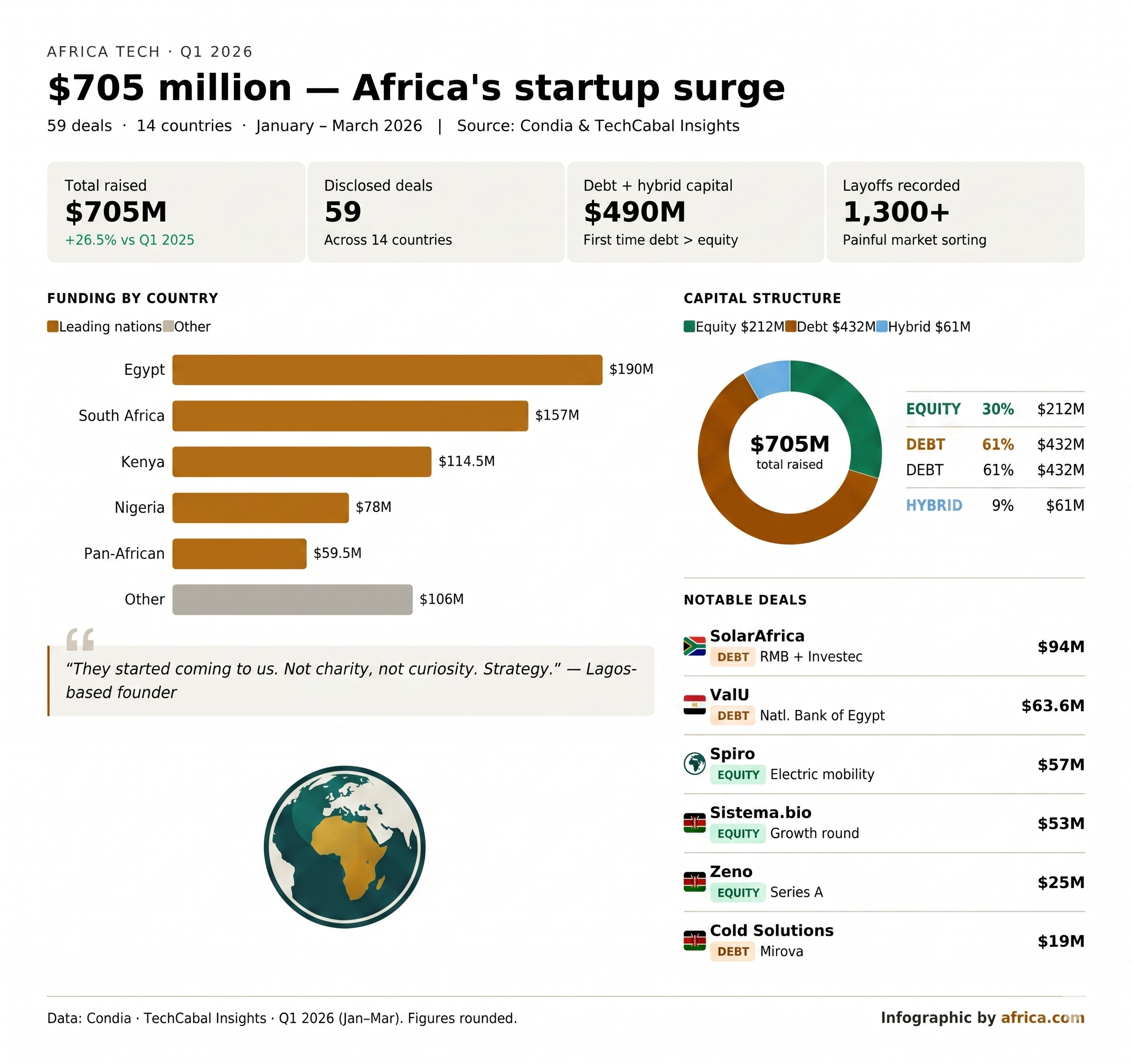
Between January and late March 2026, African startups raised $705 million across 59 disclosed deals in 14 countries — a 26.5 percent increase on the same period a year ago, according to data compiled by Condia and TechCabal Insights. The figure is not a record, but it is a statement: larger than comparable periods in 2022, 2023, or 2024, years of global venture capital retrenchment that hit African ecosystems harder than most.
Egypt led the continent, attracting roughly $190 million in disclosed funding. South Africa followed at $157 million, backed by strong institutional investors and a financial infrastructure that can absorb structured capital efficiently. Kenya secured $114.5 million across seven deals, anchored by Sistema.bio’s $53 million growth round and Zeno’s $25 million Series A. Nigeria — despite persistent macroeconomic pressure — raised $78 million and recorded the highest number of individual deals of any country in the quarter, reflecting the sheer volume of early-stage company formation happening there.
The Signal Beneath the Signal
More significant than the headline total is what lies beneath it: for the first time in the recorded history of African tech funding, debt financing overtook equity in total capital volume.
Of the 59 deals tracked, 15 were pure debt rounds and 4 were hybrid debt-equity structures — meaning nearly a third of all transactions involved some form of debt instrument. When the capital is totalled: pure equity raised approximately $212 million. Debt and hybrid instruments combined exceeded $490 million.
For much of Africa’s tech funding history, debt was what you settled for when equity dried up — a fallback for companies that couldn’t persuade venture capitalists to take the risk. The story in early 2026 looks structurally different. Egypt’s ValU raised $63.6 million in debt from the National Bank of Egypt — not because it lacked options, but because it had revenue, leverage, and the ability to borrow on its own terms. South Africa’s SolarAfrica closed a $94 million project debt round from Rand Merchant Bank and Investec. Kenya’s Cold Solutions pulled in $19 million in debt from Mirova. These are companies that have earned a different conversation.
“Investors are still deploying capital,” one analyst noted. “They’re just deploying it to companies with revenue, business models that withstand scrutiny, and paths to profitability that don’t require heroic assumptions.” That shift — from betting on potential to rewarding performance — is what ecosystem maturity actually looks like.
The Geography Is Moving
Another quiet revolution is taking place in where the deals are happening. For years, Africa’s startup capital has been concentrated in what the industry calls the Big Four: Lagos, Nairobi, Cairo, and Cape Town. Q1 2026 shows that geography beginning to shift at the margins. Dakar, Addis Ababa, and Tunis are being cited with increasing frequency as viable ecosystems by the analysts who track deal flow. Pan-African companies — startups that are built for the continent rather than for one market — raised $59.5 million in the quarter, driven heavily by Spiro’s two rounds totalling $57 million for its electric motorcycle business.
The investor base is broadening, too. Japanese investors, previously almost entirely absent from African venture capital, made a notable appearance in Q1 deal flow — a development that analysts describe as both culturally and strategically significant. While US and European capital remain dominant, the diversification of the LP base reduces dependence on any single market’s risk appetite or recession cycle.
Not Without Shadows
The picture is not uncomplicated. The same quarter that celebrated $705 million in inflows also recorded over 1,300 layoffs, including Kenyan climatetech firm KOKO eliminating its entire 700-person team after a carbon credit dispute. Neobank Kuda restructured, cutting over 100 jobs. Jumia exited Algeria. Uber ceased operations in Tanzania. Showmax announced closures. The market is sorting, and the sorting is painful for those on the wrong side of the capital threshold.
What Q1 2026 ultimately shows is an ecosystem that has completed a long and often difficult adolescence. It is neither the heroic narrative of endless promise that overseas press sometimes reaches for, nor the cautionary tale of perpetual disappointment that cynics prefer. It is something more interesting and more human: a market learning, deal by deal and founder by founder, how to allocate capital to things that work.
The investors are no longer the only ones setting terms. That, in the end, may be the most important data point of all.