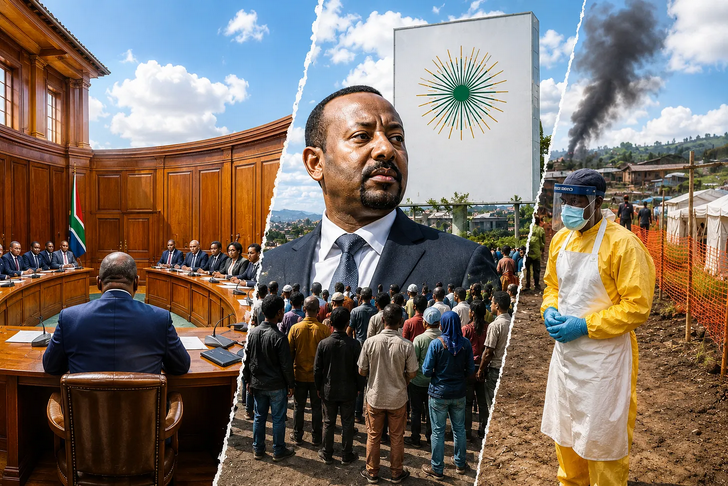
The institutions are holding. The votes are counting. The outbreak is not waiting.
THIS WEEK’S EDITION
POWER ON TRIAL » South Africa’s impeachment committee is constituted and has a chair. The process is historic. The bar for removing Ramaphosa, however, remains very high. He almost certainly has the numbers to survive it.
POWER EXTENDED » Ethiopia votes. Abiy Ahmed’s Prosperity Party is projected to dominate when results land June 11. Tigray does not vote at all.
POWER FAILING » Eastern DRC’s Ebola outbreak is a public health emergency. It is also what happens when armed conflict is allowed to destroy the institutions that contain disease.
South Africa: the committee is constituted. The bar for removing Ramaphosa remains very high.
What happened. For the first time in South Africa’s democratic history, a parliamentary committee convened to consider impeaching a sitting president. The committee is now formally constituted, with Rise Mzansi’s Makashule Gana elected as chair. The process the Constitutional Court ordered in May is now formally underway.
The constitutional protection. Removing a sitting president requires a two-thirds majority in the National Assembly. The ANC retains more than one-third of seats. That threshold is Ramaphosa’s most important shield, and it holds regardless of what the committee finds or recommends.
What the committee actually does. It reviews the 2022 independent panel findings that Ramaphosa has a prima facie case to answer on the Phala Phala farm robbery. It does not remove him. It recommends whether formal impeachment proceedings are warranted. A long process lies ahead.
Ramaphosa’s position. He has stated clearly he will not resign. He is exploring a legal review of the Section 89 panel report. Parliament is proceeding regardless. South Africa’s institutions are functioning as they should, and its constitution is being tested and holding.
Sources:The Citizen · EWN · Al Jazeera
Election » Horn of Africa / Ethiopia
Ethiopia votes. Abiy is projected to win. The caveats fill a page.
Ethiopia held its general election on June 1. Abiy Ahmed’s Prosperity Party is projected to dominate when official results land June 11. The PP ran uncontested in 64 of 547 constituencies. There are 40 opposition parties. None are serious contenders. Tigray did not vote. The election board cited unfavourable conditions following the 2020 to 2022 civil war. Polling was also disrupted across Amhara and Oromia. In Addis Ababa, there were no campaign posters. Abiy did not appear at the party’s only major rally.
What to watch: A renewed mandate gives Abiy five more years. It resolves nothing in Tigray, Amhara, or Oromia. Reports since January suggest Abiy may seek to shift Ethiopia to a presidential system, allowing him to remain in power until 2037. That move, not this election, would be the defining political development of his tenure.
Sources:Al Jazeera · Africanews · CNN
Health / Politics » Central Africa / DRC
DRC’s Ebola outbreak is a political failure as much as a public health one
DRC confirmed an Ebola outbreak in Ituri Province on May 15, the 17th in the country since 1976, arriving five months after the previous one ended. The WHO declared it a Public Health Emergency of International Concern on May 17. As of June 3, there are 344 confirmed cases and 60 confirmed deaths across DRC and Uganda. Note: WHO issued a significant data reclassification in late May, so confirmed figures are the reliable baseline while suspected case counts continue to be revised. The Bundibugyo strain has no approved vaccine.
The political dimension: WHO Director-General Tedros said it plainly: “We cannot build community trust or isolate the sick while bombs are falling.” Ituri sits at the centre of overlapping armed conflicts. Health facilities have been attacked. Contact tracing, the foundation of Ebola containment, requires community access that armed conflict destroys. This outbreak did not overwhelm a functioning system. Conflict dismantled the system first.
Sources:ECDC (June 3) · WHO · UN News
ON THE RADAR
Uganda → Museveni sworn in and signs the foreign agent bill
- Inaugurated for a sixth term on May 12, Museveni signed the foreign agent legislation days later. Civil society organisations have 60 days to register or face closure. International donors are reviewing their engagement.
Nigeria → Tinubu removes Finance Minister in targeted reshuffle
- Finance Minister Wale Edun and Housing Minister Ahmed Dangiwa were removed this week. Taiwo Oyedele, formerly Minister of State, takes over at Finance. The presidency described it as improving coordination under the Renewed Hope Agenda, with 2027 elections increasingly on Tinubu’s mind. Source
Sudan → RSF advances on El Fasher — Darfur’s last city
- The Rapid Support Forces have intensified their assault on El Fasher. The UN warns of an imminent humanitarian catastrophe. The SAF cannot resupply by air. Berlin conference pledges remain largely undelivered.
STORIES TO WATCH
Ethiopia results, June 11. Official results land next week. Watch for any signal on Abiy’s reported plans to shift to a presidential system. That is the story that matters more than the vote count.
Ramaphosa legal review. The president is exploring a legal challenge to the Section 89 panel report. If filed, it would run alongside the committee process and potentially slow proceedings. Watch whether the ANC uses that window to consolidate support around its leader.
Somalia. The constitutional crisis went quiet after May 16, but Puntland’s de facto independence holds and Al-Shabaab has reversed most of the government’s security gains. A government distracted by constitutional politics cannot fight a war. This will resurface.
Ebola corridor. Africa CDC has identified nine countries at elevated risk, including Kenya, Rwanda, and Ethiopia. Museveni has already postponed the Martyrs’ Day pilgrimage due to outbreak risk. How fast this moves beyond eastern DRC will determine whether it becomes a continent-wide political emergency.