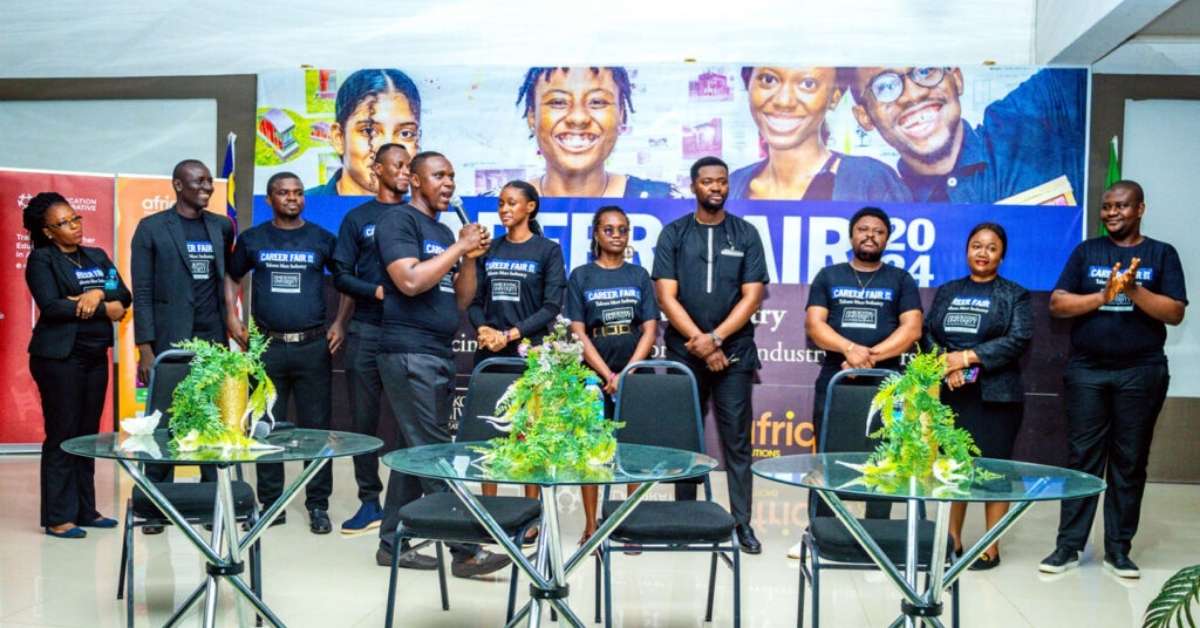
When Bashir Muhammad Idris attended a career services workshop hosted by the Education Collaborative, he returned to Limkokwing University of Creative Technology in Sierra Leone with more than just notes — he returned with a plan. Within a year, that plan had grown into a fully institutionalized career fair, drawing hundreds of students and dozens of employers, and reshaping how the university thinks about its responsibility to graduates. This is the story of how one practitioner’s insight sparked a systemic shift, and why it may be a model worth scaling across the region.
In October 2024, nearly 700 students and over 20 companies gathered at Limkokwing University of Creative Technology in Sierra Leone, for a career fair that marked a turning point for the institution.
A career fairs workshop organized by the Education Collaborative in 2024, gave Bashir Muhammad Idris, Senior Manager for Academic Management and Corporate Business Development at the university, a new perspective on how students could better connect to the world of work.

These workshops equip universities with the tools to strengthen career services, build employer partnerships, and create clear pathways from education to employment.
At the time, Limkokwing had strong academic programs and an active student body, but its efforts to connect students with employers were fragmented. Job opportunities often relied on individual staff relationships, and internships were managed separately from student services. There was no structured platform bringing students and industry together.
Bashir believed things could be different. Within a year, that belief had blossomed into an initiative that is now a permanent fixture on the university’s calendar, strengthening students’ pathways to employment.
Bashir credits the workshop for the impetus to effect change.
After participating in the workshop – designed to equip African universities with practical tools to build career- readiness strategies – he returned to campus determined to apply what he learned.
Unlike many workshops he had attended, this one was deeply practical. Participants were guided through the full lifecycle of a career fair, from planning and stakeholder mobilization to implementation and post event follow up, a phase that is often overlooked but critical to long term impact.
“The content was very comprehensive and easy to understand,” Bashir recalls. “It helped us think about everything – what to do before the career fair, during the event, and after it.”
With templates, planning tools, and support from the Collaborative, Bashir began mobilizing colleagues across the university. What began as an individual learning experience snowballed into a coordinated institutional effort, with a dedicated team formed, roles clearly defined, and industry partners actively engaged.
From Idea to Institution – Wide Action
In October 2024, Limkokwing University hosted its inaugural 2-day career fair.
The event exceeded expectations. Over 20 companies from sectors including banking, telecommunications, hospitality, and technology participated, engaging directly with nearly 700 students. The first day focused on preparing students for the job market, with workshops on CV writing, interview preparation, and cover letter development, delivered in partnership with recruitment firm Afriqia HR Solutions. These sessions brought in industry experts invited by Afriqia, offering students practical, real-world insights into employer expectations.

Afriqia’s involvement extended beyond training. Maryam Darwich, Managing Director of Afriqia HR Solutions, played a central role in shaping the programme, inviting panelists and moderating a panel discussion during the fair, which provided students with direct exposure to industry perspectives and career pathways
On the second day, students met employers face to face, creating opportunities for connection, mentorship, and recruitment that rarely happen within the classroom. Afriqia also participated as an employer, engaging students and identifying potential talent.
“It became clear to us that the career fair is a powerful platform,” Bashir says. “Instead of students graduating and searching for jobs on their own, the university can deliberately connect them with employers.”
From one-time Event to Permanent Fixture
Encouraged by this success, the university made the initiative a permanent part of its calendar. By October 2025, the second edition of the career fair had drawn 22 companies and over 500 students and was anchored by the theme, “Bridging Talent and Opportunity.”
This iteration introduced several improvements. Students participated in preparatory webinars ahead of the fair. Panel discussions featured senior industry leaders, including the Director General of Sierra Leone’s Human Resource Management Office. Afriqia HR Solutions continued its partnership, supporting student readiness and contributing to industry engagement. The university also began strengthening its monitoring and evaluation systems, introducing tracer studies to track employment and internship outcomes.
Beyond the career fair event itself, the initiative has led to systemic changes within the university.
Previously siloed but interconnected activities – internships, employer engagement, and job referrals – are now being integrated into a more coordinated career services structure. The career fair has become a catalyst for building a system that supports students from classroom learning to employment.
“It is about looking at the entire student journey,” Bashir explains. “Universities must think holistically, from learning to outcomes.”
A Model Worth Scaling
The Education Collaborative’s model of institutions sharing and scaling successful approaches is not lost on Bashir. He is eager to share Limkokwing’s success with other universities in Sierra Leone, where, according to him, structured career fairs remain rare.
“If universities take responsibility for connecting students to opportunity, the value of education becomes much clearer,” he says.
The university has begun exploring partnerships that could eventually allow the model to expand to other institutions across the country.
Bashir is keen to lead the way.
In March 2026, at the West Africa Hub Convening in Lomé, Togo, Bashir, shared Limkokwing University’s journey – now closely interwoven with his own – with higher education leaders and practitioners from across the region.
The convening followed the latest Career Strategy Workshop, held from March 22 to 24 in Lomé under the theme “Optimizing Career Services for Strong Student Employability.” The workshop brought together universities from across the region, including Bolgatanga Technical University and Accra Technical University in Ghana, Jamhuriya University of Science and Technology in Somalia, and Limkokwing University in Sierra Leone. Mentor institutions included Ashesi University in Ghana, University of Cape Town in South Africa, Botho University in South Africa, and Pan Atlantic University in Nigeria.

Interested in joining a Career Strategy Workshop? Learn more here.
This article was originally published by The Education Collaborative and is republished here with permission.
The Education Collaborative is a pan-African network advancing higher education through collaborative research, practice-driven programs, and shared accountability among universities and education leaders, with a focus on strengthening graduate outcomes and long-term institutional impact.