Weekly Intelligence Briefing for Investors, Executives, and Decision-Makers
China dropped tariffs for 53 African nations on May 1 in the most significant trade policy shift affecting the continent in years. At the same time, the Lobito Corridor moves from planning to financing, Equity Group is following trade routes south, and a South African consortium has taken over one of the world’s most troubled nickel mines at a price that reflects the seller’s pain. The thread running through all of it: who owns the assets, who controls the trade routes, and who finances the next phase of African growth.
China Drops Tariffs for 53 African Nations. The Question Is Whether Africa Can Convert Access Into Industry.
Effective May 1, China became the first major economy to offer unilateral zero-tariff treatment to all African countries with which it has diplomatic relations. The policy is significant. Its limitations are equally so.
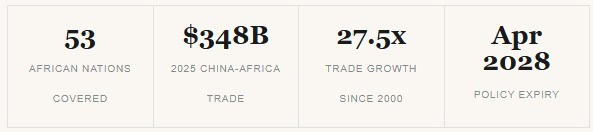
China’s zero-tariff policy now covers 53 African nations, up from 33 least-developed countries that received full access in December 2024. Eswatini is excluded for its recognition of Taiwan. The policy runs to April 2028. China-Africa trade hit $348 billion in 2025, up 17.7%, with Q1 2026 at $94.6 billion, up 23.7%. The timing is deliberate: Beijing announced on April 28 as the US enforced an Iran blockade and African finance ministers confronted a worsening energy shock in Washington. China is positioning itself as trade liberaliser at the precise moment the US is perceived to be closing doors.
WHY IT MATTERS
The opportunity is real but unevenly distributed. More industrialised African economies, South Africa, Morocco, Egypt, and Kenya, are best positioned to convert tariff-free access into manufactured goods exports. Countries with weak logistics and limited processing capacity will struggle to move beyond raw material shipments, which is precisely the trap analysts warn the policy risks reinforcing. The two-year sunset clause to April 2028 also limits long-term investment planning. The structural question for African governments and investors: can domestic industrial policy and AfCFTA value-chain development accelerate fast enough to exploit the access before it expires or is renegotiated?

» CRITICAL MINERALS · Angola/DRC/Zambia
Lobito Corridor Moves to Finance. $3 to $5 Billion in Talks with Citi, Standard Bank, and Ecobank.
The Africa Finance Corporation is in advanced talks with at least ten lenders, including Citi, Standard Bank, Absa, and Ecobank, to raise $3 to $5 billion for the Lobito Corridor construction phase. The US-backed railway links copper and cobalt mines in the DRC and Zambia to Angola’s Atlantic port of Lobito. AFC plans to launch the formal financing in Q3 2026, targeting financial close in Q4 2027 and completion by 2030. Nine engineering firms, primarily European, have submitted bids due to open within weeks. When complete, the corridor is projected to increase transport capacity tenfold and cut mineral export costs by 30%. Angola’s sovereign wealth fund and Zambia’s Industrial Development Corporation will each take 10% equity stakes.
» BANKING · Kenya/Southern Africa
Equity Group Targets Angola, Zambia, and Mozambique. The Logic Is the Lobito Corridor.
Kenya’s Equity Group is pursuing acquisitions in Angola, Zambia, and Mozambique, CEO James Mwangi confirmed to Reuters this week, following record FY2025 profits of KSh75.5 billion with 51% now earned outside Kenya. The strategy is corridor logic, not geographic ambition. “It’s not just about countries, it’s about following our customers and following trade routes.” Angola sits at the Atlantic end of the Lobito Corridor; Mozambique is the gateway for minerals flowing to Asian markets. Angola is the most advanced target, with Equity in talks for a majority stake in an undisclosed Angolan bank before year-end. The DRC, where Equity holds a 24% market share after two acquisitions, is the playbook.
» MINING · Madagascar
Sumitomo Pays $418 Million to Exit Madagascar’s Ambatovy Mine. A South African Consortium Steps In.
Sumitomo is paying $418 million to exit Madagascar’s Ambatovy nickel mine after $3 billion invested and $2.6 billion in cumulative losses. The buyer is a Jersey-registered consortium led by former Glencore nickel head Jason Kluk and South African billionaire Sandile Zungu’s Zico firm. Korea’s KOMIR retains its 45.83% stake. The deal closes by September 2026. Ambatovy produced 28,000 tonnes of nickel and 2,500 tonnes of cobalt in 2024, well below capacity, and operations were again suspended in February following Cyclone Gezani, with restart expected between May and June. Sumitomo’s distress price gives the new consortium a low-cost entry into a battery minerals asset at a moment of structurally rising nickel and cobalt demand. Whether they can stabilise what Sumitomo could not is the open question.
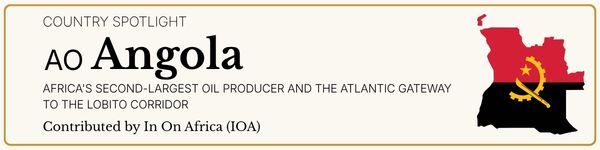
Angola sits at the centre of two of this edition’s biggest stories. The port of Lobito is the Atlantic exit point for the Lobito Corridor, carrying copper and cobalt from the DRC and Zambia to global markets, and Angola’s sovereign wealth fund is taking a 10% equity stake in the project. Separately, Luanda’s 2026 budget was built on a $61 oil reference price. Brent is above $108. How Angola manages that windfall will define its fiscal credibility with bond markets through the rest of the decade.
Sub-Saharan Africa’s second-largest oil producer after Nigeria, Angola has improved its business environment meaningfully since President Lourenco’s 2017 reforms, opening sectors to private participation and reducing state dominance. The Lobito Corridor shifts the investment thesis from a pure oil play to a logistics and minerals gateway economy. Risks remain real: corruption, slow bureaucracy, limited infrastructure outside Luanda, and a legal system requiring specialist navigation.
OPPORTUNITIES: Lobito Corridor logistics and trade finance, oil and gas upstream and services, port and rail infrastructure, construction and engineering linked to corridor development, and downstream opportunities in minerals processing. Equity Group’s acquisition interest signals growing financial services opportunity as corridor trade flows increase.
RISKS: Corruption remains a significant operational risk, particularly in government procurement. Heavy oil revenue dependence creates fiscal volatility. Infrastructure outside Luanda is limited. The legal system blends Portuguese civil law with local practice and requires specialist counsel. Currency management and repatriation of profits require careful structuring.
OPERATING TIPS: Portuguese is the language of business and government. Local partnerships are strongly advisable and in some sectors required. Luanda is one of Africa’s most expensive cities for expatriate operations; budget accordingly. The business environment has improved materially since 2017 but relationship-building with government remains essential for large projects. Allow longer timelines than comparable African markets.
Country intelligence profiles by IOA. Read the full Angola profile.

- GHANA · MINING Damang Gold Mines Limited sold its entire first output of 110 kilograms, worth approximately $11.8 million, directly to Ghana’s central bank reserves. A symbolic and commercial milestone for Ghana’s mining localisation agenda. Source
- ANGOLA · FISCAL WINDFALL Angola budgeted at $61 oil; Brent is above $108. The IMF is urging oil exporters to save windfalls rather than spend them. Bond markets will be watching. Source
- NIGERIA · TELECOMS MTN Nigeria posted Q1 2026 profit after tax of N355.5 billion, up 166% year-on-year, on revenue of N1.5 trillion, the highest quarterly figure since 2019. EBITDA margin expanded to 55.3%, in line with medium-term guidance. The result signals that Nigeria’s reform-driven macro stabilisation is translating into real earnings recovery for large-cap operators, and raises expectations for a materially higher dividend in 2026. Source
- KENYA · FINTECH Yuno partnered with Flutterwave to give global businesses easier access to African payment rails, reinforcing Flutterwave’s position as the infrastructure layer for international merchants entering African markets. Source
- STRATEGY A new Africa.com analysis by In On Africa argues that business development in Africa has become something distinct from sales: a continuous, insight-driven process of reading policy direction, mapping stakeholders, and structuring partnerships before attempting scale. The piece draws on Flutterwave’s country-by-country regulatory strategy and BasiGo’s public-private partnership model in Nairobi as examples of how BD discipline, not funding or product quality alone, determines which ventures succeed in African markets. Relevant reading for any executive planning market entry or expansion. Read on Africa.com

- Africa CEO Forum · Kigali, May 14 to 15 → Over 2,500 CEOs, heads of state, and investors convene in Kigali under the theme “Scale or Fail: Why African Capitalism Must Unite.” Kagame, Tinubu, and Dangote are all confirmed. The ownership and scale agenda connects directly to the Dangote IPO, the Lobito financing, and the China zero-tariff debate. Watch for deal announcements on the sidelines.
- Nigeria CPI · May 7 → April inflation data. Continued moderation supports the CBN’s policy stance and naira stability ahead of the Dangote IPO roadshow. An upside surprise complicates both.
- Lobito Corridor Engineering Bids → AFC opens bids from nine firms within weeks, with preferred contractors selected July to August. The award confirms which construction groups win what is expected to be one of Africa’s largest infrastructure contracts of the decade.
This Week’s Sources: Chinese State Council · Global Times · AllAfrica · CNBC Africa · Reuters · Bloomberg · Mining.com · Kitco News · Billionaires Africa · Business Tech Africa · The Exchange Africa · Kenyan Wall Street · Ecofin Agency · Africa Finance Corporation · In On Africa (IOA)
Doing Business in Africa is published weekly by Africa.com. If you found this valuable, share it with your network.