

Africa’s embrace of artificial intelligence (AI) is reshaping the continent’s future, with optimism and innovation at the forefront. A recent Africa.com survey of 1,261 respondents reveals how Africans perceive AI’s potential to transform healthcare, education, and agriculture, while addressing concerns like job displacement and ethical challenges. This report dives into the data, highlighting key insights and showcasing Africa’s unique perspective on AI’s role in driving progress.
Africans See AI as a Force for Good
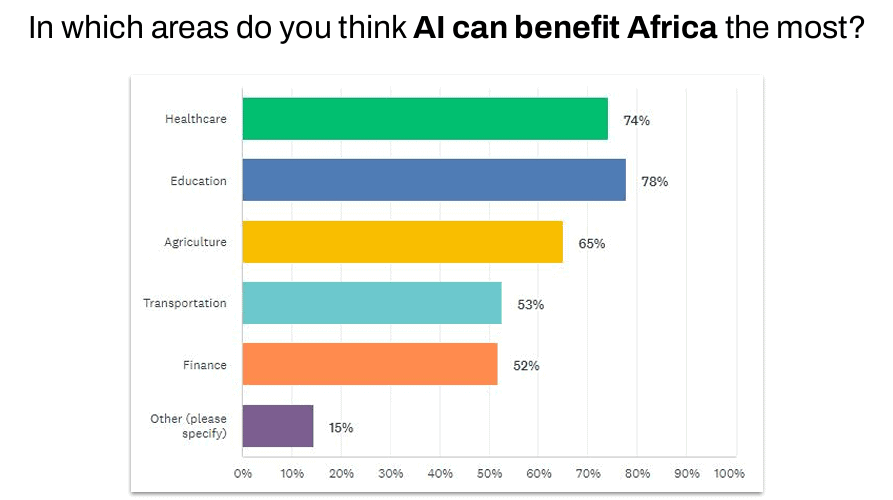
The survey, inspired by Pew Research’s study on American attitudes toward AI, shows that 78% of respondents believe AI will have a positive impact on Africa. This enthusiasm is grounded in practical applications: 74% see AI revolutionizing healthcare, 78% highlight its role in education, and 65% view it as a game-changer for agriculture. From AI-powered diagnostic tools in rural clinics to smart farming techniques boosting yields, Africans are eager to harness technology for real-world solutions.
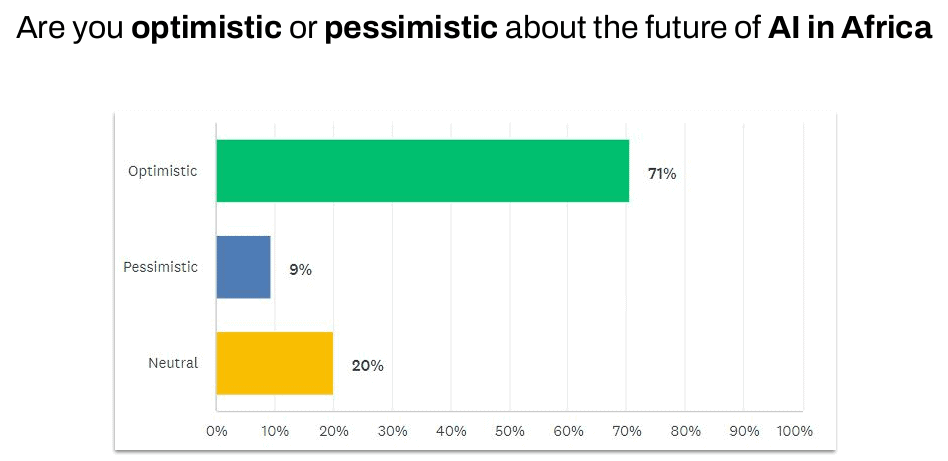
Unlike global narratives that often focus on AI’s risks, African respondents are overwhelmingly optimistic. A striking 65% feel more excited than concerned about AI’s integration into daily life, with only 15% expressing more concern than excitement. This optimism is further reflected in their outlook, with 70% feeling positive about AI’s future in Africa, compared to just 10% who are pessimistic.
Who’s Driving the Conversation?
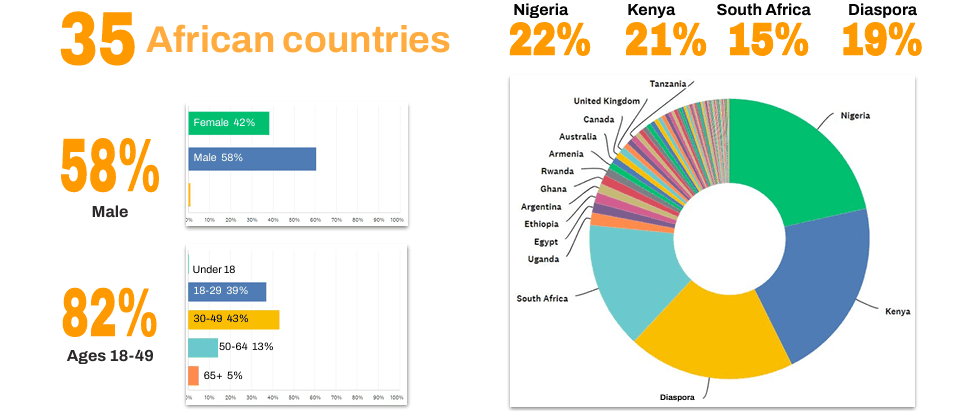
The survey’s respondents are not the average “man on the street.” Ninety-four percent hold at least one college degree, mirroring the educational profile of Pew’s American respondents. They are well-informed, with 94% reporting they have read or heard “a lot” about AI. This educated, engaged audience—58% male, 42% female, and largely aged 30-49 (43%)—represents Africa’s thought leaders, professionals, and innovators.
Geographically, the survey spans the continent, with significant representation from Nigeria (20%), Kenya (15%), South Africa (12%), and Ghana (10%). This diversity ensures a broad perspective, capturing urban and rural voices alike.
AI in Action: ChatGPT and Beyond
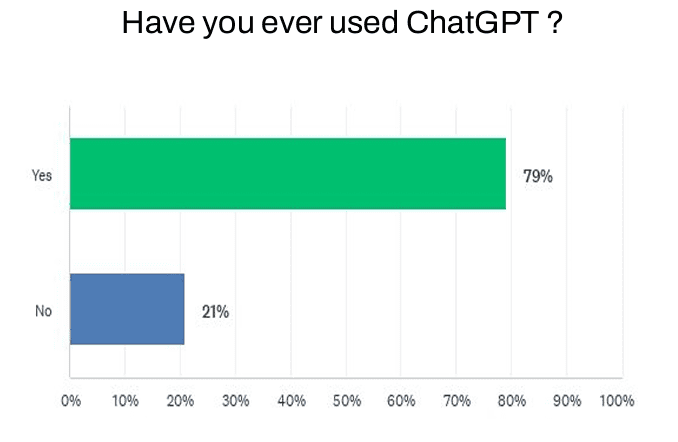
AI is already part of daily life for many Africans. Seventy-nine percent of respondents have used ChatGPT, with 60% applying it to work tasks. This high adoption rate underscores AI’s practical value, from streamlining business operations to enhancing educational resources. Respondents also see AI benefiting transportation (53%) and finance (52%), signaling its potential to modernize infrastructure and economic systems.
Open-ended responses reveal a nuanced view. One respondent likened AI to human behavior: “AI applications are exactly like humans. You have good people and bad people. It will come down to the ethical and moral choices we make.” Another emphasized the need for localized solutions, urging AI development to consider Africa’s unique socio-cultural context.
Addressing Concerns with Clarity
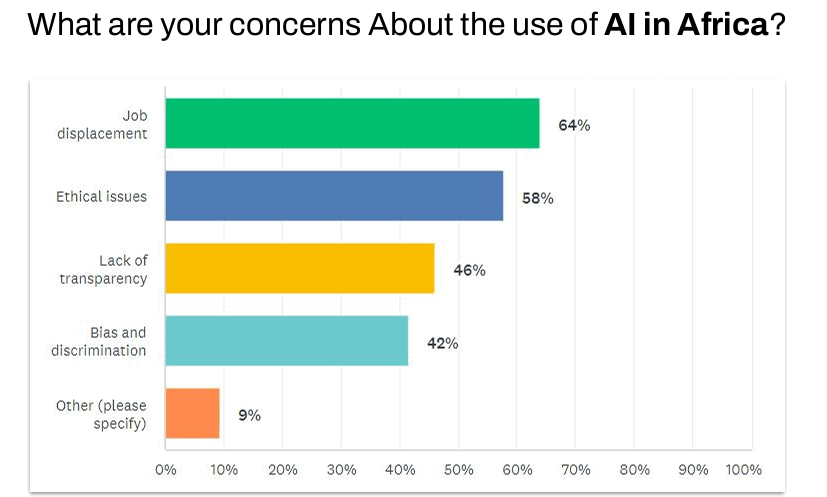
While optimism dominates, concerns exist. Job displacement tops the list at 45%, followed by ethical issues (38%), lack of transparency (32%), and bias and discrimination (28%). These worries reflect global debates but are framed with a distinctly African lens. For instance, respondents stressed the risk of Western biases in AI data, noting that “limited digital data sources” could perpetuate stereotypes if Africans aren’t involved in AI development.
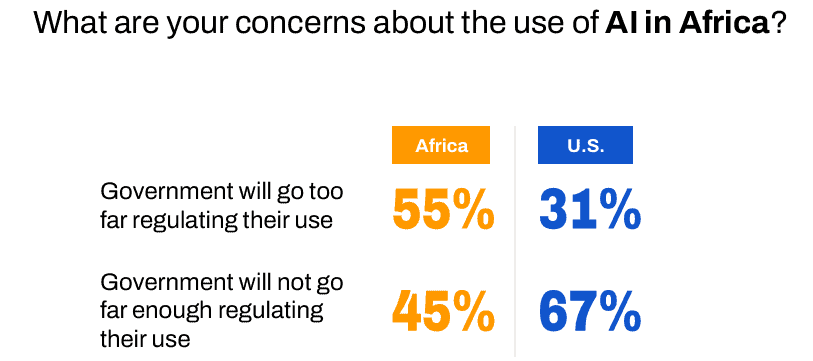
Regulation is another point of contention. Unlike U.S. respondents, where 67% worry the government won’t regulate AI enough, African perspectives are split: 35% fear over-regulation, while 40% believe governments won’t go far enough. This balance suggests a desire for thoughtful policies that encourage innovation without stifling it.
AI’s Role in Solving African Challenges
The survey highlights AI’s potential to address pressing issues. Respondents see AI helping farmers access information (68%), doctors provide quality care (65%), and companies build safer vehicles (60%). However, only 45% believe AI will protect personal information, reflecting skepticism about data privacy—a critical issue as Africa’s digital economy grows.
One respondent captured the stakes vividly: “With Africa having limited digital data sources, and with potential Western biases baked into many of these data sources… the machines that learn human tasks will be limited in their knowledge about Africa.” This underscores the urgency of African-led AI development to ensure technology reflects the continent’s realities.
A Call to Action
Africa.com’s survey paints a picture of a continent ready to lead in AI innovation. The data shows a clear mandate: Africans want AI that serves their needs, respects their values, and amplifies their voices. To achieve this, stakeholders must prioritize:
- Inclusive Development: Ensure Africans are at the table, shaping AI tools that reflect local contexts.
- Education and Awareness: Expand AI literacy to empower communities and reduce fears of job displacement.
- Ethical Frameworks: Develop transparent, bias-free AI systems to build trust.
- Investment in Infrastructure: Strengthen digital ecosystems to support AI deployment, especially in rural areas.
Africa’s AI journey is just beginning, but the continent’s vision is clear. As one respondent put it, “Africans must be at the table for this next AI chapter… so that Africa can utilize AI as a path to break free of constraints.” With optimism, expertise, and a commitment to innovation, Africa is poised to redefine AI’s global narrative.