A glimpse into the journeys of three student leaders, among many whose paths have been shaped by The Education Collaborative’s Student Leaders Program across Africa.
The African Student Leaders Program (SLP), a joint initiative facilitated by Pan-Atlantic University and The Education Collaborative, is a nine-month blended initiative that develops ethical leadership among university student leaders across the continent.
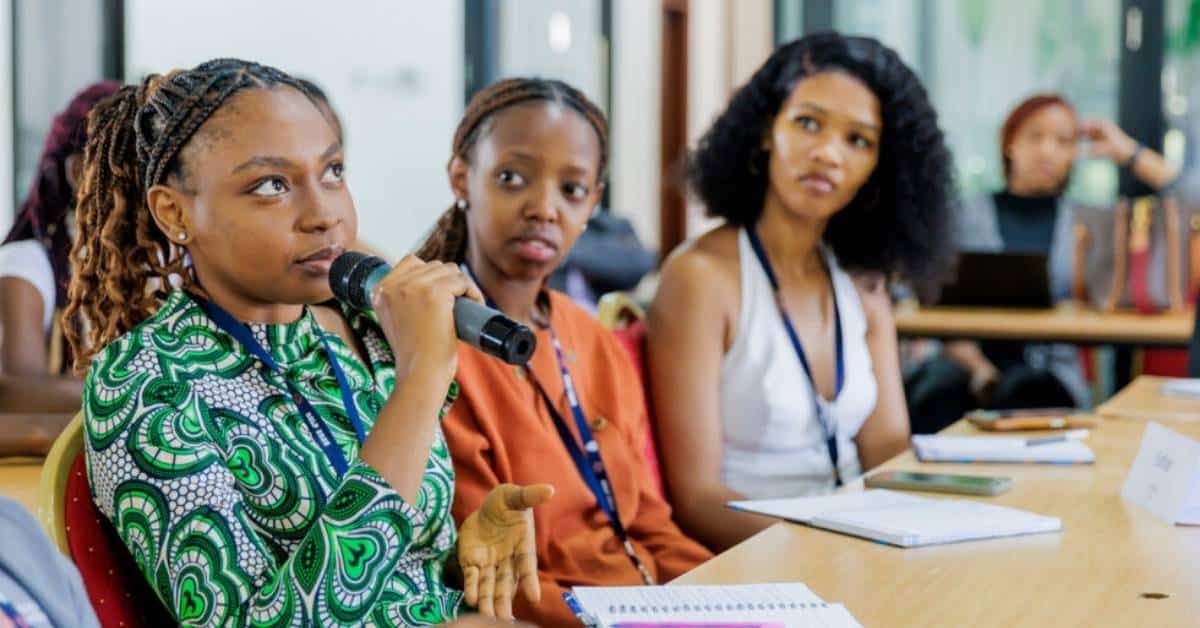
Piloted in the 2024/2025 program year, the program combines asynchronous learning with interactive virtual workshops across selected modules. These sessions are complemented by a four-day in-person leadership bootcamp (held in Kigali, Rwanda, this year) which also features the Student Leaders’ Conference. Bringing together 20 student leaders from ten universities, the program equips participants with tools, perspectives, and networks to advance ethical leadership on their campuses and beyond. Digital learning, mentorship, collaborative networks, and real-world experiences prepare students to lead with impact.
Universities and students emerge with stronger leadership, greater visibility, and connections to a community of mentors, peers, and collaborators. It culminates in the Experiential Learning Exchange – an immersive experience where students visit partner universities, engage with new cultures and leadership systems, and encounter diverse institutional contexts firsthand.
It is in this living classroom of African diversity that the stories of Edwin Makori, Frank Kimenyi, and Francis Cudjoe came alive. Across different countries, they discovered that leadership deepens through firsthand engagement with Africa: new cultures, new campuses, new leadership systems, new foods, new stories, and new versions of themselves.
Nana Ama Boa-Amponsem, Assistant Director of Programs, shares insights on the Student Leaders Program
Spotlight 1: Leadership with Open Gates – Edwin Makori
Edwin Makori, Student Council President at Strathmore University, Kenya, traveled to Rhodes University, South Africa – his first visit to the country. His journey spanned two flights, a scenic long drive, and a full day navigating travel logistics. Far from slowing him down, each stage heightened his sense of adventure.
“Even after such a marathon of travel, the moment I stepped onto Rhodes’ campus, I felt an immediate sense of excitement and possibility,” Edwin recalls.
Rhodes University was unlike anything he had imagined.
A university with open gates – literally!

Coming from Strathmore University, where security checks are strict and campus life is highly structured, this openness challenged his assumptions about safety, freedom, and trust.
Once on campus, Edwin immersed himself fully in the vibrant academic and student life at Rhodes. He met fellow students and professors, engaged with the Dean of Studies, connected with community engagement teams, and sat in on political science lectures. He also witnessed a culture that celebrates service, including a gala honoring the top 100 community-engaged students.

“Leadership thrives where students and university management collaborate and where students are encouraged to learn beyond textbooks. It’s a place where leaders learn,”
Reflecting on his experience in the program he adds:
“I made friends for life who I will invite home. This is one of the best student leadership programs I’ve ever attended. It was not just about traveling to another country – I learned deeply, exchanged ideas, and saw how other institutions operate. Africa for Africa is powerful.”
Edwin credits the nine-month program structure for its mentorship, depth of learning, and transformative engagement. Would he recommend it? His response:
“An emphatic yes! I would not only recommend it, but I would also actively promote it.”
His only suggestion to The Education Collaborative: “Extend the exchange – there is so much more to gain!”

Spotlight Story 2: Values Across the Atlantic – Frank Kimenyi
Frank Kimenyi, Student Council Vice President at Kepler College, Rwanda, flew to Pan Atlantic University (PAU), in Nigeria for his exchange. Before the trip, he had spent months immersed in the program’s online Giving Voice to Values (GVV)course, which reshaped his understanding of ethical leadership and identity.
“I am encouraged to discover my own values… to understand what I stand for,” he reflects.
His travel preparations were intense – visa applications, yellow fever vaccinations, multiple trips to the embassy – but his excitement remained high. Having already met brilliant PAU student leaders and faculty at the bootcamp in Kigali earlier, he knew the exchange would be meaningful.
And it was.

Contrary to stereotypes, Frank found Nigerians warm and deeply hospitable:
“The community was very kind… the opposite of what I had feared.”
He bonded easily with students and staff, engaged in thoughtful conversations about ethics and leadership, and even experienced the Atlantic Ocean for the first time:
“It was my first time seeing the Atlantic… they made it happen.”

One of the most remarkable lessons came from observing how PAU student leaders interacted with university leadership.
At PAU, he experienced a genuine open-door policy, similar to Kepler’s, but far more advanced in practice. Wherever the exchange group went, student leaders confidently led the way, moving from one office to another without requiring special protocol or escorts.
He was struck by how freely student leaders knocked on the doors of Vice Chancellors and senior administrators – always met with warm, welcoming smiles. The accessibility and trust were unmistakable.
He also noted the intentional design of the administrative spaces: many offices had glass doors, ensuring visibility, safety, and accountability.
“It showed how much the administration values transparency and student engagement,” he reflects. “Students could easily see whether professors were in, and professors were always willing to receive them.”
The environment gave him a new appreciation for how physical spaces and leadership culture shape student voices.
In PAU’s classrooms and governance structures, he saw a model of discipline, intellect, and ethical consistency seamlessly aligned with the GVV principles he had been studying.
The trip deepened his conviction:
“Absolutely, I would recommend this program – 100%.”

Frank with members of the Get Together Student Men’s Group following his address
Spotlight Story 3: Leadership, Learning, and Life – Francis Cudjoe
Francis Cudjoe, President of the Junior Common Room at the University of Ghana Business School, traveled to Cavendish University, Uganda.
Originally scheduled for Nigeria, he was reassigned to Uganda, where he spent five immersive days – his first visit to East Africa.
Arriving in Kampala at night, tired but eager, he awoke to a vibrant city alive with motion.
“Kampala is vibrant and full of energy,” he says. “It feels like a city that never slows down.”
He was impressed by the roads, the movement of people, and the widespread use of motorbikes as a primary mode of transport. “The movement, the pace, the interaction between people – it all showed just how dynamic the city is,” he reflects. “It gave me a deeper appreciation for how urban life functions differently across Africa.”
From day one, Francis was inspired by Cavendish University’s student-centered culture. He and his fellow participants met with senior leadership, including the Vice Chancellor and the Dean of Student Affairs, Dr. Olive Sabiiti.

Francis and fellow student leaders meet Dr. Olive Sabiiti, Vice Chancellor and Dean of Student Affairs at Cavendish University
“They listened to us deeply and treated us like partners,” he recalls. “The Vice Chancellor was like a mother to us – very accessible and very invested in student life.”
A standout for Francis was the fully equipped media studio for journalism students.
“It showed me the power of hands-on, skills-based learning,” Francis says. “It’s something I would love to see replicated at my home institution.

Francis testing the microphone at the Journalism Studio
He observed additional governance strengths, including a structured charity system for financially challenged students and strong student access to senior leadership.
“These are practical systems that make leadership more responsive,” he says. “They are ideas worth adapting back home.”
Francis describes the SLP as the best leadership program he has joined. It strengthened his confidence, expanded his leadership capacity, and inspired him to pursue further ethical leadership training.
His one suggestion to The Education Collaborative: “Extend the exchange period to allow for deeper cultural immersion.”

Francis and fellow student leaders share a moment together
Why the Exchange Matters:
For Edwin, exposure to diverse governance structures revealed strengths, gaps, and new possibilities for leadership back home.
For Frank, the program dispelled stereotypes, built confidence, and grounded leadership in shared African identity.
For Francis, it broadened empathy, sparked innovation, and deepened both personal and professional growth.
In Francis’s words:
“This program is exceptional, from the bootcamp to the exchange. The facilitators are welcoming, responsive, and deeply committed. The impact is real and is shaping the next generation of African leaders.”
Learn more about the Student Leaders Program by sending an email to: education.collaborative@ashesi.edu.gh

This article was originally published by The Education Collaborative and is republished here with permission.
The Education Collaborative is a pan-African network advancing higher education through collaborative research, practice-driven programs, and shared accountability among universities and education leaders, with a focus on strengthening graduate outcomes and long-term institutional impact.