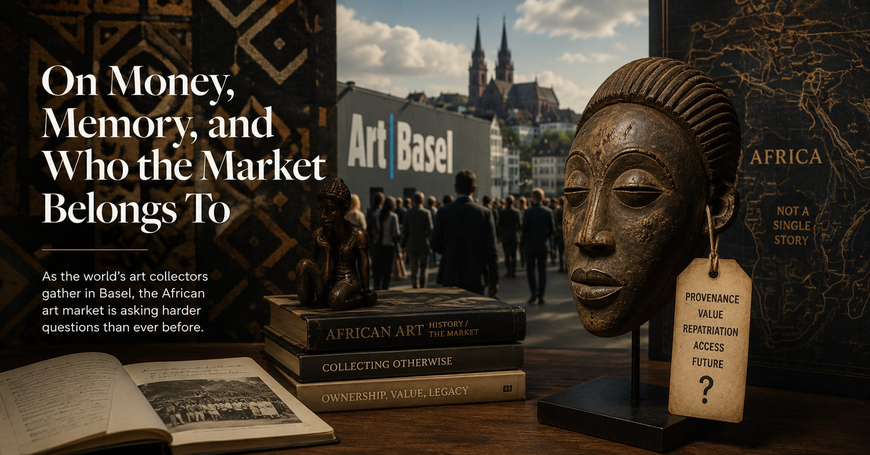
As the world’s art collectors gather in Basel, the African art market is asking harder questions than ever before.
The Art of African Vision is produced by Africa.com. Africa’s story has long been told through someone else’s lens. This newsletter exists to complicate that. Every issue we go where the African art world is moving: into the auction rooms and artist studios, the biennales and backstreet galleries, the conversations that are reshaping what gets made, what gets valued, and who gets to decide. This week, those conversations are happening at full volume. We are listening.
The Room Where the Money Is
This Thursday, on the same day that the Obama Presidential Center opens in Chicago, Sotheby’s will hold its “Art of Africa, Oceania, and the Americas” sale in New York. The timing is not coincidental. Art Basel week has become the gravitational centre of the global art market calendar, and everyone, from the major auction houses to the smallest independent galleries, positions their most significant activity around it.
The sale title itself is worth pausing on. African objects are grouped alongside Pacific and Indigenous American material under a single umbrella, a categorisation that says something about how the Western auction market still thinks about non-European art: as a collective other, defined by what it is not rather than what it is. That framing is increasingly contested, and the debate around it is one of the most important in the African art world right now.
The prices achieved this week will be read, analysed, and argued about by collectors, dealers, and artists across the continent and diaspora for months. They will influence which artists get gallery representation, which collectors enter the market, and which works get made. That is a great deal of power to concentrate in a single room on a Thursday afternoon in New York.
The question this newsletter has always wanted to ask about that room is not who is buying. It is who is setting the terms. African art has, for most of the past century, been valued by institutions and markets that did not include African collectors, African dealers, or African auction houses in any significant way. That is changing. But slowly, and unevenly, and not without resistance.
Artist Spotlight: Aisha Aliyu-Bima, and the Fellowship That Bears a Great Name
This week at Art Basel, a 27-year-old Nigerian curator named Aisha Aliyu-Bima is in Basel as the inaugural recipient of the Koyo Kouoh Fellowship, a new programme launched by Art Basel in collaboration with RAW Material Company in Dakar.
The fellowship is named for Koyo Kouoh, the Cameroonian-Swiss curator who shaped the 2026 Venice Biennale’s vision, In Minor Keys, before her death in May 2025. For those who knew her work, the choice of inaugural fellow is precisely right. Aliyu-Bima is based in Abuja, where she is Director of Arts at the African School of Economics. Her practice spans curation, writing, photography, and archival research, with a particular focus on Northern Nigerian and Sahelian contemporary arts: the Hausa language and its cultural reach across the Sahel, the material and ecological dimensions of African art, and the histories that orthodox art-world narratives tend to overlook.
She has produced exhibitions in Lagos, Abuja, Kaduna, Kano, and Budapest. She has held residencies in Paris and Lagos. She is, by any reading, serious: someone who has been building a practice patiently, away from the centres of attention, in places the international art world rarely looks.
The fellowship gives her time and access at the most commercially significant art week in the world. What she does with that access will be worth watching. The Koyo Kouoh Fellowship is not a prize for past achievement. It is a bet on future importance. And the person who conceived of RAW Material Company, who championed African artists from Dakar to Cape Town to Venice, chose well in who she inspired it to support.
Deep Roots: The Nok Terracottas
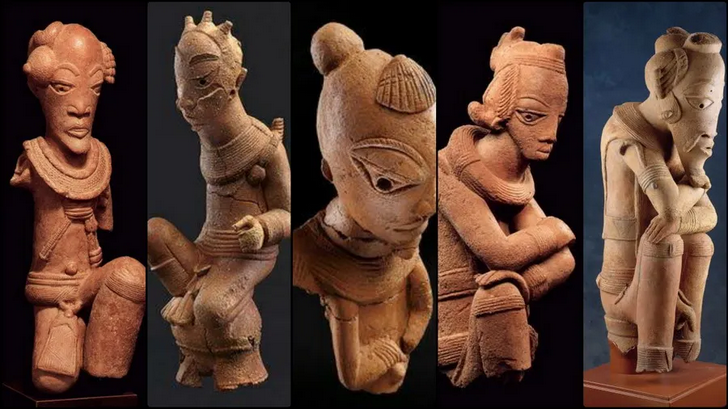
Long before any auction house catalogued an African artwork, long before any European collector “discovered” the continent’s artistic traditions, the people of the Nok culture in what is now central Nigeria were making some of the most extraordinary sculpture in the ancient world.
The Nok terracottas: hollow, fired clay figures produced between roughly 1500 BCE and 500 CE, are the oldest known figurative sculpture in sub-Saharan Africa. They are extraordinary objects. The figures are highly stylised, with hollow eyes, elaborate hairstyles, and an attention to human anatomy that speaks to a sophisticated and sustained artistic tradition. Some are small enough to hold in one hand. Others stand nearly a metre tall. They were made across a wide geographic area, suggesting a culture of significant scale and complexity.
We do not know what they were for. We do not know the names of the people who made them. We do not know what language they spoke or what they called themselves. The Nok culture left no written records, and its relationship to later Nigerian cultures remains a subject of active scholarly debate.
What we do know is that they are extraordinary. And what we also know is that thousands of them were looted from archaeological sites in the 20th century and sold to collectors and museums in Europe, America, and Japan. Nigeria has been seeking their return for decades. Some have been repatriated. Most have not.
The Nok terracottas are a reminder that the story of African art and the story of its theft are not separate narratives. They are the same story, told from different ends.
That story is still being written. In January 2026, Turkey’s ambassador to Nigeria announced that Turkey had identified 76 wooden and metal objects believed to be of Nigerian origin and was ready to begin formal repatriation discussions. It was a striking moment: Turkey, a country known for aggressively pursuing its own looted artefacts from Western institutions, extending that same principle of cultural justice to an African nation. The Nigerian government is currently verifying ownership. The objects may yet come home.
On the Global Stage: Basel, Chicago, and a Week That Will Be Remembered
This is the week when the threads come together.
Art Basel runs from June 18 to 21 at Messe Basel, with 290 galleries from 43 countries. Ibrahim Mahama’s The God of Small Things stands on the Münsterplatz. Africa Basel runs at Klybeck 610 through Sunday, its curated programme of artist conversations and critical discourse running alongside the market rather than inside it. Aisha Aliyu-Bima is in the city as the inaugural Koyo Kouoh Fellow.
On Thursday, the Obama Presidential Center opens in Chicago on Juneteenth. Njideka Akunyili Crosby’s portrait of Barack and Michelle Obama hangs in the main lobby, the first image every visitor sees. Thirty artists’ site-specific works are installed across a campus that cost $850 million to build.
Also on Thursday, Sotheby’s holds its African Art sale in New York.
Three cities, three events, one week. African artists, African curators, and African art are at the centre of the most significant cultural moment of the year. The market, the institution, and the street are all moving at once.
We are not here to tell you this is enough. It is not enough. But we are here to say: notice it. Because moments like this one are not accidents. They are the result of decades of work by artists, curators, dealers, and advocates who refused to accept that this was not possible.
Museum Feature: The Smithsonian National Museum of African Art, Washington D.C.
There is a museum in Washington D.C. that has been making the case for African art in the United States for more than sixty years, and it deserves more attention than it usually gets.
The Smithsonian National Museum of African Art, founded in 1964, is the only museum in the United States dedicated exclusively to the arts of Africa. Its collection spans more than 12,000 objects: ancient and contemporary, from across the continent and diaspora. It holds significant holdings of sub-Saharan sculpture, textiles, ceramics, and photography, alongside a growing collection of contemporary work.
This year, the museum is co-sponsoring the Strauss and Co. African Art in Venice Forum, bringing its curatorial voice into the global conversation around the Venice Biennale and the state of the African art market. That kind of institutional engagement, using a Washington museum’s authority and platform to amplify African artists in European and global contexts, is exactly the function a publicly funded institution should be serving.
The museum is free to enter, part of the Smithsonian complex on the National Mall, and consistently under-visited relative to its neighbours. If you are in Washington, go. If you are not, its online programming is extensive and worth your time.
Smithsonian National Museum of African Art, 950 Independence Avenue SW, Washington D.C. africa.si.edu
Want to explore art institutions across the continent? Africa.com’s Museums of Africa guide is your country-by-country companion to heritage collections, contemporary art spaces, and cultural institutions from Cairo to Cape Town. Explore the full guide at africa.com
A Final Word
The Nok terracottas were made by people whose names we do not know. The griots who sang at the courts of the Mali Empire are gone. The women who dyed the first bogolan cloth left no record of their names.
And yet the work survived. The work always survives.
This week in Basel and Chicago and New York, living artists are adding their names to that long, unbroken line. We are here to make sure those names are written down.