On censorship, silence, and the art that refuses to disappear.
Africa’s story has long been told through someone else’s lens. This newsletter is here to change that. We dive deep into the world of African and diaspora art, where every canvas, sculpture, photograph, and installation is an act of reclamation. From the mud-cloth weavers of Mali to Afrofuturist painters reshaping Lagos, from the street muralists of Johannesburg to the gallery walls of New York, Paris, and Accra, we follow the thread of African creativity across centuries, borders, and movements.
The Body as Archive
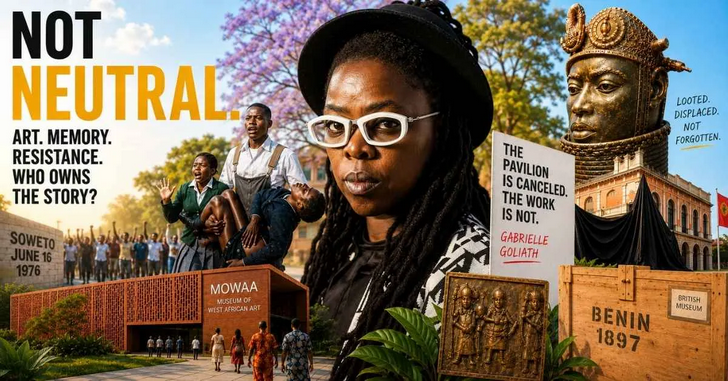
There is a photograph taken in Soweto in 1976. A teenager named Hector Pieterson is being carried through the street, shot by apartheid police during the student uprising. The image was taken by Sam Nzima, a Black South African photojournalist working for The World newspaper. It went around the globe. It became one of the defining images of the 20th century.
What is less often told is what happened to Nzima afterward. His camera was confiscated. He was threatened. He fled Johannesburg and returned to his home village in Limpopo, where he ran a small shop for years, largely forgotten by the international press that had profited so enormously from his image.
His story is not an exception. It is a pattern. African artists and image-makers have long created the work that moves the world, while the credit, the money, and the narrative control flow elsewhere.
This newsletter exists to interrupt that pattern. Not with outrage alone, but with something more durable: attention, context, and the insistence that the people who make the work are the people whose names we remember.
Artist Spotlight: Zanele Muholi, Seeing in Black
To look at a Zanele Muholi self-portrait is to understand that photography can be an act of will.
In March 2026, Muholi was named the laureate of the Hasselblad Award, the world’s most prestigious prize in photography, joining a list that includes Henri Cartier-Bresson, Nan Goldin, and Cindy Sherman. A major solo exhibition follows at the Hasselblad Center in Gothenburg this October. The recognition feels overdue, and also exactly right. This is also the 20th anniversary of Faces and Phases, the landmark portrait series that first brought Muholi’s vision to the world. There is no better moment to pay attention.
Muholi is a South African visual activist and photographer whose work centres on the lives, bodies, and dignity of Black LGBTQIA+ people in South Africa and beyond. Born in Umlazi, Durban in 1972, they began photographing in the early 2000s, driven by what they described as the near-total invisibility of Black queer life in the South African media and art world. Faces and Phases became one of the most important bodies of documentary photography produced anywhere in the world in the past two decades: hundreds of portraits of Black lesbian, bisexual, and transgender individuals, each one a record, a witness, and an act of love.
But it is Muholi’s later series, Somnyama Ngonyama (Hail the Dark Lioness), that has brought them global recognition. In these extraordinary self-portraits, Muholi turns the camera on themselves, using found objects (rubber gloves, steel wool, hair rollers, electrical cables, rope) to construct images that are by turns regal, confrontational, sorrowful, and incandescent. The skin is rendered almost impossibly dark, intentionally so: Muholi has spoken of using high contrast to reclaim the darkness of Black skin as something magnificent rather than something to be softened for a white gaze.
The images ask, directly, who gets to decide what a Black body looks like. They answer that question by refusing to negotiate.
“This prize is not mine alone. I carry it with the many faces, names, and histories that have trusted me with their stories.”
Deep Roots: The Bronze Casters of Benin
In 1897, British forces sacked the royal palace of Benin City in what is now southern Nigeria. They killed the king’s men, sent the Oba into exile, and looted the palace of thousands of objects: carved ivory tusks, wooden altarpieces, coral regalia, and above all, bronze plaques and sculptures of extraordinary complexity and beauty.
These objects, now known collectively as the Benin Bronzes, ended up in museums and private collections across Europe and North America. The British Museum alone holds more than 900 of them. For more than a century, they sat in glass cases in London, Paris, Vienna, and Chicago, described in catalogue entries that frequently marvelled at their technical sophistication while struggling to reconcile that sophistication with prevailing assumptions about African civilisation.
What those catalogue entries rarely said plainly enough is this: the bronze casting tradition of Benin is one of the great artistic achievements in human history.
The casters, members of the Igun Eronmwon guild, have been at work in Benin City for at least six centuries. Their technique, lost-wax casting, produces objects of staggering precision. The guild is hereditary: the craft passes from father to son, carrying with it not just technical knowledge but an entire cosmology, a set of relationships between the living and the dead, the human and the divine, the king and his people.
Today, Igun Eronmwon guild members still cast in Benin City. They are producing new work, continuing old forms, and increasingly, engaging with the repatriation debate as artists rather than simply as stakeholders. Some have travelled to London to see, for the first time, works made by their ancestors. The encounter is, by all accounts, something that no catalogue entry could prepare you for.
The bronzes are coming home. In February 2026, the University of Cambridge transferred legal ownership of 116 Benin artefacts to Nigerian authorities. Hundreds more are expected to follow from museums in Sweden, Britain, and Germany before the year is out. The questions of who owns the returned objects, where they will be housed, and whether the public will have access remain fiercely contested. But the return has begun, and the guild is ready.
On the Global Stage: The Empty Pavilion
At this year’s Venice Biennale, South Africa’s pavilion in the Arsenale is sitting empty. Not through neglect or lack of funding, but by government decree.
In January, South Africa’s Minister of Sport, Arts and Culture, Gayton McKenzie, cancelled the planned pavilion by artist Gabrielle Goliath just days before the Biennale deadline. The work in question, Elegy, is an ongoing performance and video series that Goliath has been developing since 2015. It mourns the unjust deaths of specific individuals: a South African teenager killed in 2015, Nama women massacred during German colonial rule in Namibia, and Palestinian poet Hiba Abu Nada, killed in an Israeli airstrike in Gaza in 2023. McKenzie demanded changes to the work. Goliath refused. The pavilion was cancelled.
Goliath and curator Ingrid Masondo challenged the decision in court, arguing the minister lacked the contractual authority to cancel and that the decision violated Goliath’s constitutional right to freedom of expression. The court dismissed the case in February without providing reasons.
Rather than accept the cancellation, Goliath found an alternative venue. Elegy opened in May at the Chiesa di Sant’Antonin in Venice’s Castello district, just a short walk from the Biennale’s main exhibition, sponsored by the Bertha Foundation and London art space Ibraaz. It runs through July, then travels to London in October. The South African pavilion remains vacant.
The story cuts to the heart of everything this newsletter is about: who controls the African narrative, who gets to decide what African artists can say, and what happens when an artist refuses to be silenced. The empty pavilion is, in its way, as powerful a statement as anything that could have hung on its walls. Elegy itself is reported to be extraordinary: seven singers emerging one by one from darkness, each holding a single sustained note, the slow accumulation of grief made audible and undeniable.
Museum Feature: MOWAA, Museum of West African Art, Benin City
No museum on the continent is more entangled in the questions this issue raises than the Museum of West African Art in Benin City, Nigeria.
MOWAA was conceived as a home for West African heritage on West African soil: a place where the bronzes, the carvings, and the histories that have spent centuries in European institutions could be encountered in the city that made them. Designed by Ghanaian-British architect David Adjaye, the museum sits on a 15-acre campus in Benin City and houses an inaugural display spanning three millennia of West African art and culture.
Its opening in November 2025 did not go smoothly. Protests erupted during preview events. The Governor of Edo State revoked the museum’s land certificate. Questions about ownership, governance, and who truly controls the institution became impossible to ignore. The museum is currently open by appointment only, navigating a deeply contested political landscape.
That contestation is, in many ways, the point. MOWAA’s existence forces questions the African art world cannot avoid: when the bronzes come home, who decides where home is? When African heritage is reclaimed, who gets to hold it? MOWAA is not a comfortable institution. But it may be one of the most important ones on the continent.
MOWAA, 1 Benin Sapele Road, Benin City, Nigeria. wearemowaa.org
Want to explore more institutions across the continent? Africa.com’s Museums of Africa guide is your country-by-country companion to heritage collections, contemporary art spaces, and cultural institutions from Cairo to Cape Town. Explore the full guide at africa.com
A Final Word
The South African government cancelled Gabrielle Goliath’s pavilion. They took away the venue, the funding, and the official platform. What they could not take away was the work itself.
Elegy opened anyway. Seven singers in a church in Venice, each holding a single sustained note, mourning the dead by refusing to be silent. The pavilion sits empty. The work goes on.
That is, in the end, what this newsletter is about. Not the institutions, not the pavilions, not the prize money or the auction results. The work. The work that gets made regardless, that finds its audience through back doors and borrowed churches and word of mouth, that carries its meaning across borders and centuries and every attempt to stop it.
The story of African art is not a story of what was taken. It is a story of what could not be.