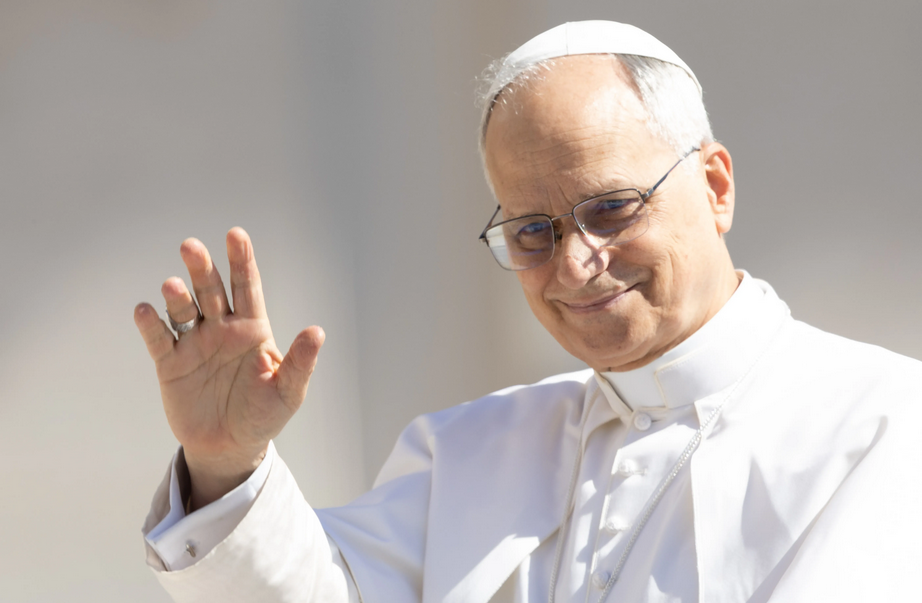
The rain came down on Algiers the morning Pope Leo XIV touched African soil for the first time as pontiff. The welcoming ceremony had to be moved indoors — a small concession from a country that does not easily bend. A young girl stepped forward and offered the pope a bouquet of flowers as an honor guard stood at attention and Algerian President Abdelmadjid Tebboune waited, hand extended. It was a Monday in April, and a door that had never opened before swung quietly, finally, wide.
For a man who proclaimed himself “a son of St. Augustine” from the very first words of his papacy, Algeria is not foreign soil. It is, in a way, ancestral. St. Augustine served as bishop of Hippo — present-day Annaba — for three decades, and died there in A.D. 430. Robert Francis Prevost, the Chicago-born friar who became Pope Leo XIV, has built his spiritual life in the shadow of that North African giant, repeatedly citing the church father in his speeches and homilies. Now, at 70, he has come to walk in those ancient footsteps himself.
Africa is no longer the periphery of global Catholicism — it is its beating centre. More than 20 percent of the world’s Catholics now live on the continent, and Africa contributed more than half of the 15.8 million people baptised Catholic in 2023 — some 8.3 million new African Catholics in a single year. Yet for decades, Vatican itineraries have lingered in Europe and Latin America. Pope Leo XIV’s decision to make Africa the destination of his most ambitious journey signals a fundamental reckoning: the Church’s future is being written here, in Douala and Luanda and Annaba, not in Rome.
Bridges Across an Old Wound
Algeria is a nation that knows what it costs to be misunderstood by the West. Hundreds of thousands died in the revolution against France, during which detainees were tortured, suspects disappeared, and villages devastated as part of a strategy to maintain colonial grip on power. The pope did not sidestep this history. At the Martyrs’ Memorial in Algiers, he tied his appeal for peace directly to Algeria’s struggle for independence, telling the crowd: “God desires peace for every nation, a peace that is not merely an absence of conflict but one that is an expression of justice and dignity.”
Algeria is 99 percent Sunni Muslim, with fewer than 9,000 Catholics — a community made up largely of foreigners — living among a population of more than 45 million. And yet, the Archbishop of Algiers, Cardinal Jean-Paul Vesco, offered a detail that says more than any statistic: on any given day, nine out of ten people who visit the Our Lady of Africa basilica are Muslim. “It’s wonderful,” he said, “to be able to show that we can be brothers and sisters together, building a society despite our different religions.”
That is the wager Leo XIV has placed — and it is a bold one. Mistrust of Western culture and Christianity remains high in Algeria, much of it rooted in the memory of French colonialism, and Christians in the country frequently face difficulties. Proselytizing to Muslims is a crime. Some churches have been shut. A young student named Selma Dénane, who lives in Annaba, voiced what many Algerians were quietly asking: “I imagine it’s a good thing that a pope is visiting Algeria. But what will it change afterward? Will Christians be able to say, ‘I am a Christian’ without fear or stigmatization?”
The pope has no simple answer to Selma’s question. But he has come anyway.
The Road South
After two days in Algeria, Leo will travel to Cameroon, Angola, and Equatorial Guinea — a whirlwind crossing of 11 cities and towns, spanning nearly 18,000 kilometres across 18 flights. He is expected to deliver 25 speeches over those 11 days, covering everything from the exploitation of natural resources to political corruption — pointed words for a continent where Cameroon and Equatorial Guinea are led by presidents who have held power for decades and have been accused of human rights abuses.
The journey’s emotional crescendo is likely to come on Friday, when 600,000 people are expected to gather for an open-air Mass beside the Japoma Stadium in Douala, Cameroon. It will be one of the largest Catholic gatherings on the continent in years — not a performance of power, but a portrait of a faith that has taken deep, irreversible root in African soil.
Before he gets there, though, Leo will spend Tuesday morning in Annaba, visiting the Basilica of Saint Augustine — walking the same ground where the bishop of Hippo once ministered, argued, and prayed. There is something quietly extraordinary about that image: a pope from Chicago, shaped by centuries-old Algerian theology, kneeling in an African city that the world mostly overlooks, listening — as Augustine once wrote — for the restless heart that cannot rest until it finds what it is looking for.
Africa, it seems, is where Leo XIV has chosen to look.