ByKeren Landman
As Ebola cases mount in the Democratic Republic of the Congo, experts explain what causes the disease—and the risk this outbreak poses to the rest of the world.
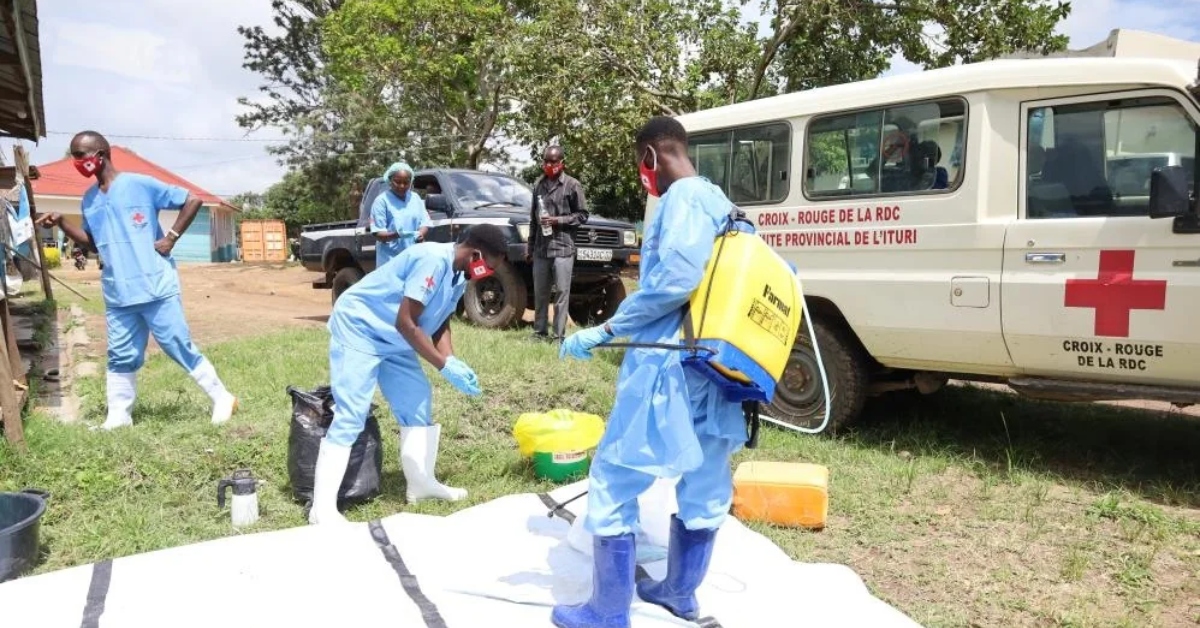
The World Health Organization has declared a Public Health Emergency of International Concern following an Ebola outbreak in the Democratic Republic of the Congo (DRC) and in neighboring Uganda. The declaration is the second-noisiest alarm the agency can ring on an outbreak, and a signal to other member states to activate their national response and preparedness systems. WHO Director-General Tedros Adhanom Ghebreyesus noted in remarks to press that he “determined that the situation was not a pandemic emergency,” the agency’s new and highest classification for outbreaks.
As of May 20, officials say the outbreak has led to 139 deaths and nearly 600 suspected cases. Fifty-one cases have been confirmed in towns in the remote, densely forested northeastern Ituri province, and Uganda has confirmed two cases.
For Nahid Bhadelia, an infectious disease doctor and founding director of Boston University’s Center on Emerging Infectious Diseases, the initial details took her back to 2014’s massive West African Ebola epidemic.
“The delay of months for identification, the presence in multiple urban areas before detection, cases in many different geographically disparate places,” she said—all these were parallels to the present and indicated an outbreak that had simmered undetected for some time before boiling over.
But how much risk does the Ebola outbreak pose to the rest of the world? Here’s what you need to know about Ebola virus and how it spreads.
How does Ebola spread, and why is it so dangerous?
Ebola viruses belong to the Filovirus family, which also includes Marburg viruses. Four species of Ebola viruses cause disease in humans: Zaire is most common, while the one responsible for this outbreak, Bundibugyo, is rare. That means it’s harder to diagnose and, unlike the Zaire virus, there are no vaccines or treatments for it.
Like other Ebola viruses, Bundibugyo causes flulike symptoms—fever, muscle aches, and fatigue—that often progress to severe diarrhea, vomiting, and bleeding. Symptoms vary enough from person to person that infections can often be mistaken for malaria or typhoid if diagnostic testing isn’t done. It’s a dangerous disease: Between one-third and half of people who get infected with the virus die as a result.
Although it’s not clear who was the first person infected in this outbreak, its explosive spread is thought to have started with a death on May 5, according to Anne Ancia, a World Health Organization representative in the DRC. Speaking at a press conference on May 19, she said the body of a person who died in Bunia, the capital of the Ituri province, was transported to a smaller town, then moved from their original coffin because “the family decided that the coffin was not worth the person.”
Ebola outbreaks usually start when someone becomes infected during contact with an Ebola-infected animal. They spread when people have direct contact with the body fluids of others who are sick or have died from the infection, including urine, saliva, sweat, feces, breast milk, amniotic fluid, and semen. Importantly—and in contrast to COVID-19, flu, and many other infections—infected people without symptoms are unlikely to transmit Ebola to others.
In the parts of sub-Saharan Africa where Ebola is most common, the infection often spreads when family members touch the body of a loved one during burial preparations, then have contact with others attending the funeral; something similar likely lit this outbreak’s spark, Ancia said.
Surviving Ebola largely depends on early diagnosis and getting the kind of care people receive in intensive care units—like intravenous rehydration and medicines to maintain blood supply to vital organs. For that reason, deaths due to Ebola infection are highest in places where access to health care is lowest.
This article was originally published by National Geographic.