In this personal essay, Cameroonian writer and DBA candidate Loïc Gapin reflects on a Peugeot 504 that has sat unmoved in his family’s compound in Yaoundé for thirty years. What begins as a meditation on one parked car becomes a reckoning with structural adjustment, inherited silence, and the education a generation received in place of everything else that was taken.
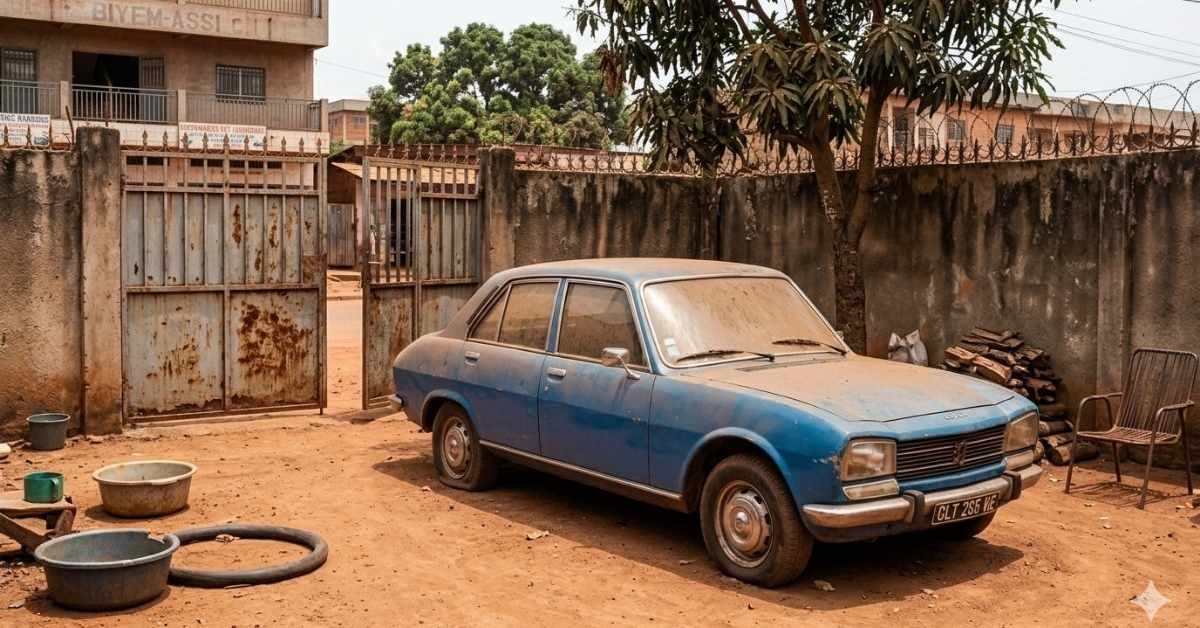
The Peugeot 504 is still in the compound.
It has been there for thirty years. It no longer runs. My father has never moved it, never sold it, never explained its presence in the practical language of maintenance or utility. When I ask him why it stays, his answer is the same each time, given with the quiet finality of a man who has considered the question long enough to be done with it.
“It reminds me,” he says.
I did not understand, for a long time, what it reminded him of. I was a child when he parked it, and children do not read the grammar of adult grief. They absorb its texture without decoding it, the way you absorb the smell of a room without knowing what is burning. The car simply sat there in the compound of our family home in Biyem-assi, Yaoundé, losing its colour gradually to the sun, becoming part of the landscape of my childhood the way a scar becomes part of a face. Ordinary. Present. Unremarkable to me, though it was not unremarkable to him.
My father drove that Peugeot 504 to work at the Ministry of Public Service for years. In the Cameroon of the late 1980s, the 504 was a car that signified something. Not luxury, which was a different category entirely, but competence, arrival, the quiet evidence of a man who had worked and built something and could, on a Sunday, load his family into a vehicle that belonged to him and go somewhere. My father was proud of it with the pride of men who are proud of things they have earned: quietly, without apology, without needing the pride to be seen.
Then the International Monetary Fund and the World Bank came for the country.
I mean this in the most literal sense. In the late 1980s, Cameroon, like many African nations of the period, was in fiscal difficulty and turned to international creditors for assistance. The assistance came with conditions. The conditions became what was known as the Structural Adjustment Programme: cut government spending, privatise state enterprises, liberalise trade, devalue the currency, eliminate subsidies. The theory was that these measures would remove inefficiencies and allow market forces to produce sustainable growth.
What they produced, in our house in Biyem-assi, was a salary that no longer covered what it had once covered. A civil servant’s income hollowed out by reductions and then, in January 1994, halved overnight by the devaluation of the CFA franc. The price of fuel rose in ways that a Ministry of Public Service salary, revised downward, did not rise to meet. My father made the calculation that any reasonable man makes when the arithmetic is that clear. He parked the car.
He said nothing about what this cost him.
This is the detail I have thought about most, across all the years of thinking about that car. Not the parking. The silence around it. My father was not a man who trafficked in grievance. He had watched the ground shift beneath him, had watched the modest and reasonable life he had built get restructured by people in Washington who had never sat in a power cut in Yaoundé, and he absorbed the restructuring with a dignity that I was too young to fully appreciate and too close to fully see. He did not become bitter. He did not allow the diminishment of his material circumstances to diminish his vision of what his children could become. He took public taxis to work and came home and asked about our homework and said, when the opportunity arose, that education was the finest inheritance a parent could pass to a child.
L’éducation est le meilleur héritage qu’un parent puisse transmettre à son enfant.
He was not speaking abstractly. He was speaking as a man who had watched everything else become subject to devaluation, and who had understood, through the experience of losing it, what could not be repossessed. The structural adjustment economists could cut his salary and hollow out the institutions around him and halve the purchasing power of the currency in his pocket. They could not take back what had already been put into the minds of his children.
I went to school in an anglophone system, despite being the only anglophone in a francophone family, because my parents trusted the judgement of a professor friend who recommended it. I learned in a language no one at home could help me with, which meant I had to build the competence alone, from the inside out, through sheer refusal to accept incomprehension as a permanent condition. I grew up to study in the United States and the United Kingdom, to work in oil and gas in Douala, to run community development programmes in the rural highlands of the West Region, and to pursue a Doctorate in Business Administration while my children sleep in the rooms behind me and the ceiling fan turns slowly and the electricity goes out and comes back and I sit with my books at two in the morning.
None of this happened despite the parked car. It happened because of it. Because a man who received a blow that would have broken other men’s vision chose, instead, to make the future of his children into something no macroeconomic prescription could reach. The car is still in the compound because it is the evidence of that choice. The material monument to what was taken, and to everything that was kept.
I am writing a book about that inheritance. About what it means to grow up in a country shaped by structural adjustment, to carry that formation across three continents, and to choose, against the reasonable advice of most of the people around you, to come home. About what a generation owes to the people whose silence made its education possible. About the difference between a country’s potential and the political arrangements that have prevented that potential from being realised.
The book is called My Father Parked His Car. It will be published by Les Éditions du Schabel.
The car is still in the compound. I have a long way to go before I understand everything it reminds him of.
But I am trying.
Loïc Gapin is a Cameroonian writer, accountant and DBA candidate based in Douala. He works in the energy sector and writes on African political economy at loicgapin.substack.com. He is the author of My Father Parked His Car (Les Éditions du Schabel, November 2026).