
The Boom List: Africa’s Fastest-Growing Economies in 2026

If you want to understand where the world’s most dynamic economies are right now, you may need to start by looking at a map of Africa.
While much of the developed world grapples with sluggish growth, ageing populations and the lingering aftershocks of pandemic-era disruptions, a cohort of African nations is expanding at a pace that would make most finance ministers elsewhere quietly envious.
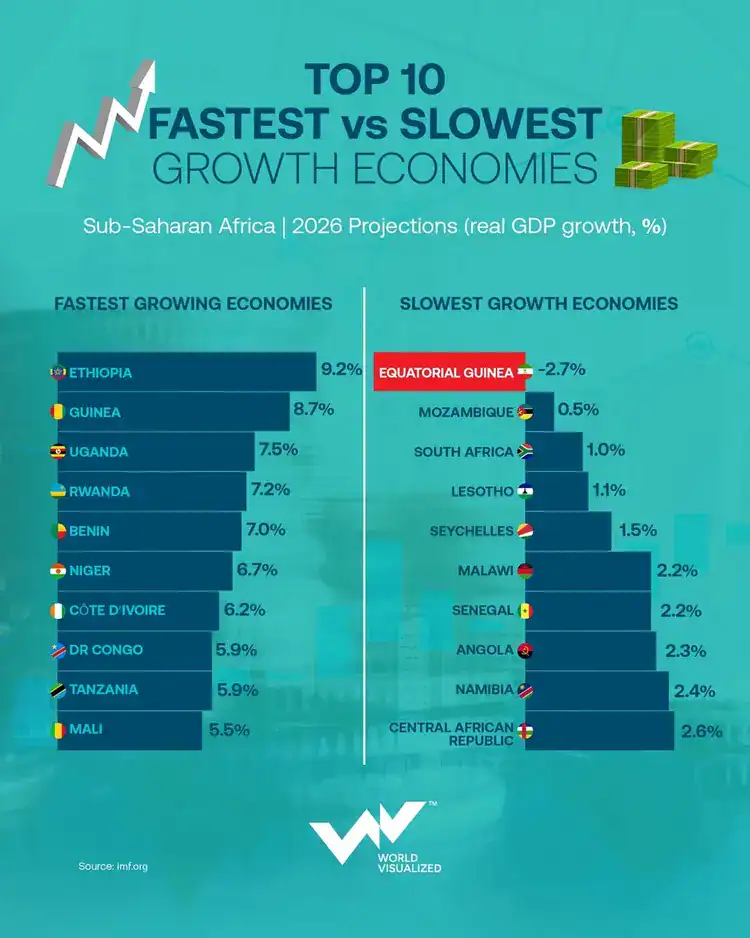
The International Monetary Fund’s latest regional projections for 2026 make for striking reading: several African economies are expected to post growth rates above 7%, driven by a combination of natural resources, infrastructure investment, policy discipline and — in some cases — sheer demographic momentum.
This is not the Africa of outdated narratives. This is something more interesting.
Ethiopia: Africa’s Reluctant Giant Keeps Running
At the top of the IMF’s 2026 growth projections for the continent sits Ethiopia, forecast to expand by approximately 9.2%. It is a remarkable figure for an economy that has navigated political turbulence, a devastating civil conflict in its northern Tigray region, and persistent macroeconomic pressures including a foreign currency crunch.
The drivers, the IMF notes, are sustained public investment, a broadening services sector and a gradual recovery in economic stability. Ethiopia has also leaned heavily on its industrial ambitions — the country has invested significantly in industrial parks designed to attract export-oriented manufacturing — and on the sheer scale of its domestic market, the second-largest population on the continent.
The 9.2% projection is not a story of a country that has solved all its problems. It is a story of a country with enough momentum, and enough underlying structural advantages, to grow rapidly despite them.
Guinea: Bauxite and the Business of Building Wealth
Close behind Ethiopia sits Guinea, projected to grow by 8.7% in 2026. The engine here is unmistakable: mining. Guinea is one of the world’s largest producers of bauxite, the ore from which aluminium is refined, and rising global demand for the metal — driven in part by the clean energy transition and the explosion in electric vehicle manufacturing — has turned the country’s geological endowment into a powerful economic force.
Foreign investment has followed. Major mining companies have committed significant capital to Guinea’s extractive sector, and the revenues are flowing through the economy. The critical question for Conakry, as it is for any resource-driven economy, is whether this boom is being used to build something durable — or whether Guinea risks becoming the next cautionary tale of the resource curse.
For now, the numbers are impressive.
Uganda, Rwanda and the Infrastructure Story
Uganda is projected to grow by 7.5%, with the IMF pointing to infrastructure development and the anticipated scale-up of its nascent oil sector as key contributors. For a landlocked country that has waited years for its petroleum reserves to begin generating revenue, the prospect of oil exports adds a new dimension to an economy already expanding through agriculture and services.
Rwanda, projected at 7.2%, is perhaps the most distinctive story on the list. This is not a resource boom. Rwanda has almost no extractive industry to speak of. Its growth is built on something harder to replicate: consistent, disciplined governance, a deliberate strategy to position Kigali as a hub for regional services and technology, and a policy environment that has, over two decades, proved stable enough to attract sustained investment. The IMF credits exactly these factors.
It is, in a region sometimes defined by instability, a remarkable outlier.
Benin, Niger, Côte d’Ivoire and the West African Wave
The list of fast growers extends deep into West Africa. Benin and Niger are both projected to post strong growth — 7.0% and 6.7% respectively — supported by infrastructure spending and deeper regional trade integration. Côte d’Ivoire, consistently one of the region’s more stable and diversified economies, is forecast at 6.2%, underpinned by agriculture, construction and services.
The Democratic Republic of Congo and Tanzania are each expected to grow by 5.9%, with mining and tourism anchoring their respective expansions. Mali rounds out the IMF’s top ten at 5.5%, a figure that speaks to a rebound in key sectors even as security challenges persist.
What This Tells Investors
The IMF has noted that fast-growing African economies are increasingly powered by a mix of natural resources, urbanisation and genuine policy reform. That combination — when it holds — creates real opportunities. The continent’s demographics, its infrastructure deficit and its untapped domestic markets mean the runway for growth, in the right conditions, is long.
Africa’s boom list is not a guarantee. It is, however, an argument — a compelling one — for paying closer attention.