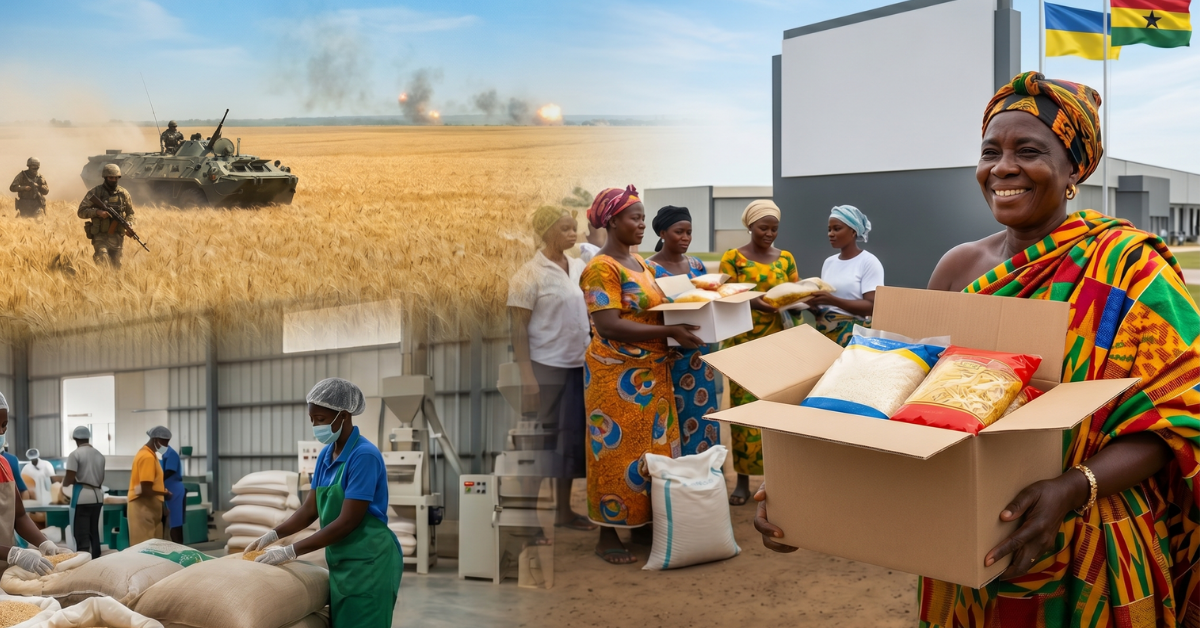
On the morning of April 14, 2026, a woman in Accra lifted a food package she had not expected to receive. Inside: rice, and pasta made from flour milled in Ghana — from Ukrainian wheat. The woman was one of 4,000 Ghanaian widows who received packages at the opening of Ukraine’s first agricultural hub on the African continent. Thousands of miles away, a war raged. Along the front lines of eastern Ukraine, soldiers were fighting over the same land that had grown the grain that found its way into her hands. The connection between the two realities — the battlefield and the basket — is precisely the point Ukraine is trying to make.
A Country That Must Sell Its Way to Survival
Ukraine entered the war in 2022 as one of the world’s great agricultural powers — the fifth-largest wheat exporter globally, a country whose black soil had fed empires and republics alike. The Russian invasion shattered its traditional trade architecture. Ports were blockaded. Routes were mined.
European Union trade quota disputes emerged as the war dragged on. Ukraine adapted: it reoriented exports aggressively toward Asia, Africa, and the Middle East. Last year, the African market bought $2.8 billion worth of Ukrainian agricultural goods — a number that would have seemed implausible before the war began.
The Ghana hub, launched as part of President Volodymyr Zelensky’s ‘Food from Ukraine’ initiative, is the next phase of that strategy. Ukrainian Prime Minister Yuliia Svyrydenko, who announced the opening on April 14, described it as ‘a new format of our presence in the world, where humanitarian support is combined with the development of partnership and the local economy.’
The facility serves as a food processing and distribution centre — combining Ukrainian wheat and other goods with locally produced Ghanaian products, assembling food packages, and distributing them across West Africa.
Why Ghana
The logic of choosing Ghana is not accidental. The country is entirely dependent on wheat imports, spending approximately $400 million annually on grain it does not grow. Between 2022 and 2025, Ghana’s wheat imports surged by nearly 57 percent, reaching roughly 1.09 million tonnes, as demand for bread, pasta, and noodles continued to rise alongside a growing urban population.
Food insecurity in the country has reached a decade-long high, affecting over two million people. Ghana’s own ‘Feed Ghana Programme’ has been seeking precisely the kind of agricultural technology, storage infrastructure, and processing capacity that Ukraine can provide.
The two countries signed a memorandum of cooperation at the Food from Ukraine conference in November 2025. The agreement covers joint initiatives for agricultural technology exchange, business and research institution cooperation, and — critically — the construction of a wheat-flour processing plant that would convert raw Ukrainian grain into finished products on Ghanaian soil. Ukraine has also pledged to distribute approximately five million seed packets and invest in storage infrastructure to reduce post-harvest losses.
The Model Behind the Hub
What makes the Ghana centre distinctive is not simply the food it distributes, but the model it represents. Ukraine is not dumping surplus grain on a willing recipient and calling it aid. It is positioning itself as an integrated partner in West Africa’s food supply chain — selling, processing, training, and cooperating simultaneously. The next phase of the hub will involve packaging, portioning, and processing of Ukrainian goods directly in Ghana, creating local employment and embedding Ukrainian products deeper into the regional economy.
For Ukrainian farmers who spent years watching their exports choked by European quota disputes and then redirected through mined corridors, Africa represents something more than a market — it represents survival, and a future that does not depend on the goodwill of neighbours who may not always be friends. For Ghana, the hub offers a chance to move up the value chain: from buying raw grain to hosting the means of processing it.